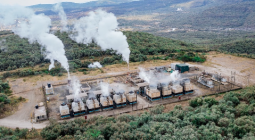


When Next-Generation Geothermal Meets First-of-a-Kind Reality
Eavor is a next-generation geothermal energy company that set out to solve one of the long-standing limits of geothermal power. Conventional geothermal electrical generation only works where naturally permeable, water bearing hot rock exists close enough to the surface. Eavor’s idea was different. Instead of relying on naturally flowing hot fluids, it proposed drilling deep, sealed loops of pipe through hot rock, circulating a working fluid through them, extracting heat by conduction, and bringing that heat to the surface for electricity generation or industrial and district heat.
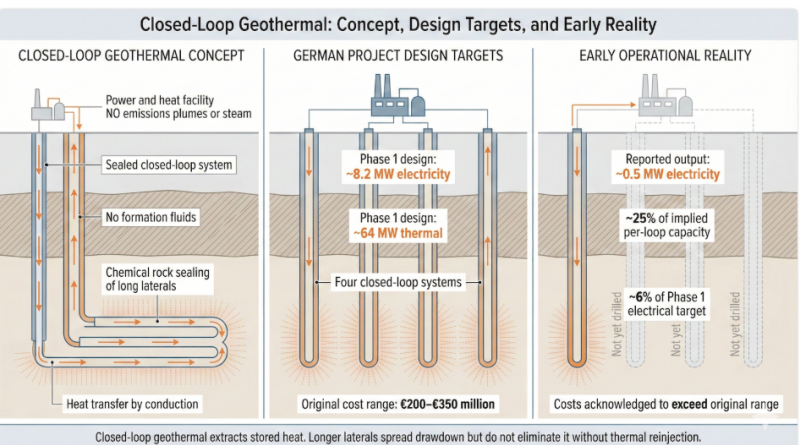
In late 2025, Eavor’s flagship project in Geretsried, Bavaria, began feeding electricity into the German grid. The reported output was about 0.5 MW. The original Phase 1 plan for the site was about 8.2 MW of electricity from four loops. With one loop operating, that places the project at roughly 25% of the implied per loop capacity, and about 6% of the Phase 1 electrical target, after project costs have already exceeded the originally stated €200 to €350 million range. Eavor’s press releases were very positive about generating electricity, and very light on details related to intent or costs.
The early performance figures discussed here come from reporting by GeoExPro, the online publication of a long-running geoscience and subsurface energy trade magazine, drawing in turn on German geothermal industry sources and on-record comments from Eavor representatives. They were brought to my attention by Simon Todd, a PhD of geology focused on geothermal industrial heat, someone with whom I spent a bunch of time last year discussing the space (part 1, part 2). The second half has our discussion on Eavor.
GeoExPro is not an advocacy outlet and is read primarily by geologists, drilling engineers, and subsurface specialists, with an editorial history that includes both conventional oil and gas and emerging geothermal technologies. Its reporting on the Geretsried project relies on publicly stated project targets, German trade publications focused on deep geothermal development, and direct attempts to confirm operating data with the company itself, making it a technically literate but independent source rather than a promotional or polemical one.
Eavor’s claimed intent was to address three real problems that have limited geothermal expansion for decades. First, high quality hydrothermal reservoirs are geographically scarce. Second, enhanced geothermal systems that fracture rock to create permeability have struggled with induced seismicity and regulatory resistance. Third, open-loop geothermal systems can suffer from declining output as reservoirs cool or lose pressure. Eavor’s closed-loop concept claimed to avoid all three. No produced fluids. No fracturing. No reliance on natural permeability. In theory, drill deep enough anywhere with a sufficient geothermal gradient, lay enough horizontal pipe through hot rock, and heat would flow into the loop in a predictable, controllable way.
This promise attracted attention quickly. Investors, policymakers, and utilities were looking for firm, dispatchable low carbon energy that could complement wind and solar. A closed loop geothermal system appeared to offer baseload heat and power—ignoring the challenges of inflexible generation integrating with variable generation—without fuel costs, emissions, or the siting constraints of conventional geothermal. Eavor branded its subsurface loops as radiators embedded in hot rock, scalable by drilling more loops, and inherently safer than enhanced geothermal approaches. The idea was not particularly fringe. It was a credible attempt to apply drilling expertise from the oil and gas sector to a different energy problem.
Germany was an interesting place for Eavor to try to prove the concept at commercial scale. Bavaria has an active geothermal sector, with multiple district heating systems already operating. Germany’s energy transition has left it short of firm low carbon heat and power, especially after the nuclear phaseout and the sharp reduction in Russian gas imports. Policymakers were willing to support novel geothermal approaches that promised both electricity and large quantities of heat. Geretsried, a town south of Munich, became the site of Eavor’s first full scale commercial demonstration, not a pilot but a project explicitly framed as a scalable model. Why it wasn’t tried in California is a question that’s left dangling.
The Geretsried project was laid out in phases. Phase 1 consisted of four closed loop systems intended to deliver about 8.2 MW of electricity and roughly 64 MW of thermal output for district heating. Longer term concepts discussed in earlier years envisioned dozens of additional loops and much larger aggregate output. Financing reflected this ambition. Public disclosures in 2024 described a total expected investment of up to €350 million, supported by a €91.6 million grant from the EU Innovation Fund and loans from the European Investment Bank and a syndicate of commercial and development banks. This was framed as first of a kind commercial deployment risk, not an inexpensive experiment.
I began assessing Eavor and related geothermal concepts years ago as part of broader assessment of geothermal’s role in the energy transition. My view, stated repeatedly in articles and analysis through 2024 and 2025, was that geothermal heat is often undervalued and geothermal electricity is frequently oversold. Conventional geothermal can be excellent where conditions are right. Shallow and medium depth geothermal for district heating can be highly effective. Deep, closed loop geothermal for electricity faces a much steeper set of thermodynamic and economic constraints. I did not dismiss Eavor as unserious. I consistently framed it as innovative engineering with unproven economics at scale, especially for power generation rather than direct heat.
My global geothermal assessment culminated in a full length report published in 2025 examining the hype and reality of geothermal energy across multiple technologies and geographies. The report separated mature geothermal applications from speculative ones, and emphasized that drilling depth, temperature, and conversion efficiency matter far more than elegant conceptual diagrams, and far more than pitch decks. It argued that next generation geothermal concepts are first of a kind megaprojects, where early optimism collides with physical limits and capital discipline. Black swans swarm around the concepts. It also emphasized that geothermal’s strongest roles are in heat delivery and seasonal storage, not in competing with wind and solar for electricity.
That report summarized geothermal as a family of technologies rather than a single solution. Conventional hydrothermal systems were shown to be proven but geographically limited. Enhanced geothermal systems carried seismic and cost risks that remained unresolved. Closed loop geothermal eliminated some risks but introduced others, especially around heat transfer rates, thermal drawdown, and drilling cost. The central conclusion was not that geothermal should be abandoned, but that policy and investment should distinguish clearly between what has demonstrated bankable performance and what remains exploratory.
Understanding the current situation at Geretsried suggests a primer on how closed loop geothermal actually works would be useful for many. A closed loop geothermal system circulates a fluid through sealed pipes drilled through hot rock. Heat flows from the rock into the pipe by conduction. The fluid carries that heat to the surface, where it can be used directly for heating or converted to electricity using an organic Rankine cycle or similar technology. The rock does not supply flowing hot water. It supplies stored thermal energy.
Eavor’s approach to sealing its long horizontal heat exchange sections is not a conventional “run casing and cement it” completion. In its Eavor-Lite disclosures, the vertical sections are cased and cemented using standard oil and gas practice, but the multilateral open hole sections are sealed using what the company calls its Rock-Pipe completion system, which is a chemical sealant and operating method designed to permanently block near wellbore porosity and small fractures while drilling and then maintain that seal during operations. The mechanism described in Eavor’s technical publications is based on an alkali-silicate drilling fluid that stays liquid in the wellbore but penetrates into pore space and flow paths in the surrounding rock, where it can be triggered to solidify.
The key step for very long laterals is the follow-on chemical flush. After drilling, a reacting treatment is pumped through the well at sufficient pressure to leak off into the near wellbore region and contact any unreacted silicate left in the formation, initiating precipitation and hardening in place. The company’s patent literature describes reactants such as calcium chloride brine, acids, and CO2 for this flush. Practically, the point is that the seal is created within the rock matrix itself, not as a thin coating on the borehole wall, and the chemical flush is the step intended to make that seal continuous and durable across kilometers of open hole lateral where conventional mechanical isolation would be difficult and expensive.
At small scales, the closed loop distinction may seem academic. At megawatt scales, it is central. The natural geothermal heat flux from the Earth’s interior is small, measured in tens of milliwatts per square meter. Producing megawatts of useful heat or power requires drawing down the stored heat of a large volume of rock. In effect, a closed loop geothermal system mines a thermal battery. Heat flows in from surrounding rock and from deeper layers, but far more slowly than heat is extracted when operating at industrial scale.
Extending horizontal laterals and increasing the total length of pipe increases the surface area available for heat exchange. This spreads heat extraction over a larger volume of rock and reduces the temperature drop near the pipe wall. It delays thermal interference and helps maintain outlet temperature for longer. What it does not do is change the basic energy balance. Without returning heat to the same rock volume, the average temperature of that volume will decline over time. Longer laterals buy time. They do not create new energy.
This matters more when heat is converted to electricity. Electricity generation from geothermal heat is constrained by basic thermodynamics. At the temperatures typical of deep geothermal systems outside volcanic regions, conversion efficiency is low. Producing 1 MW of electricity can require several megawatts of thermal extraction. Every improvement in electrical output accelerates thermal drawdown unless offset by reinjection of heat.
Geothermal systems can be managed as seasonal thermal stores if surplus heat is available at the right time and temperature. District heating networks with large summer heat surpluses or industrial waste heat sources return heat to the subsurface and regenerate the resource. Industrial heat loads are flatter and do not produce surplus heat for reinjection. In those cases, closed loop geothermal remains extractive, not regenerative.
Drilling is the other critical constraint. As drilling goes deeper and laterals extend further, risks increase nonlinearly. Temperatures rise. Pressures rise. Tool wear increases. Directional control becomes harder. Small deviations compound over kilometers. Failures are expensive and often irreversible. Each additional kilometer drilled carries more uncertainty than the last. This is not a software learning curve. It is a physical one.
Research on megaproject risk by Professor Bent Flyvbjerg and his team, shows that large infrastructure projects fail less because of ignorance than because of compounded optimism. Known risks are treated as independent when they are not. Tail risks are discounted. Early successes are extrapolated too confidently. Deep geothermal projects concentrate many such risks in one place: geology, drilling, heat transfer, conversion efficiency, and capital intensity.
Against this backdrop, the current facts at Geretsried matter. Public reporting from German geothermal industry sources indicates that one closed loop system is now operating and delivering roughly 0.5 MW of electricity to the grid. The Phase 1 design target of about 8.2 MW implied roughly 2 MW per loop across four loops. On that basis, current per loop output is around 25% of the implied average. In terms of total Phase 1 output, it is closer to 6%.
At the same time, Eavor representatives have acknowledged that project costs have exceeded the originally stated €200 to €350 million range. That statement refers to costs, not future budget envelopes. There is no public audited figure for total spend to date, but the acknowledgment places €350 million as an upper bound already crossed.
It is also important to be clear about what has not happened. The other three Phase 1 loops have not been drilled in parallel. Public reporting indicates that drilling of the second loop is planned for 2026. There is no evidence of completed but idle loops waiting to be connected. Most of the capital spent so far has gone into drilling and commissioning the first loop and into shared surface infrastructure such as the power conversion system and grid connection. The additional loops represent future capital expenditure, future risk, and future uncertainty, not deferred value already built.
This combination is analytically significant. Cost risk has already materialized. Performance risk remains unresolved. The economic case now depends on later loops delivering materially higher output per loop and doing so at lower incremental cost. That is possible, but it is not yet demonstrated.
None of this implies that closed loop geothermal is worthless or that Eavor’s work lacks value. It does suggest that several of the low probability risks discussed in abstract terms over the past decade are now appearing together in practice. Lower than expected per loop output, higher than expected capital costs, and unresolved thermal drawdown dynamics are not independent. They reinforce each other.
For the narrative to change, a few things would need to happen. Subsequent loops would need to demonstrate higher sustained thermal and electrical output than the first. Incremental drilling costs would need to fall meaningfully despite increasing depth and lateral length. Heat focused applications would need to dominate the economics, reducing the thermodynamic penalty of electricity conversion. Evidence of managed thermal regeneration would need to appear, not just modeling assumptions.
Geothermal remains an important part of a diversified energy transition, especially for heat. Closed loop geothermal remains an interesting engineering approach. Geretsried now provides the first real commercial scale data point for that approach. The early numbers do not settle the debate, but they narrow it. They suggest that the constraints identified in theory are beginning to assert themselves in practice, and that the black swans were not hidden. They were listed, discounted, and are now arriving together.
Cover photo: Google Gemini generated this infographic comparing closed-loop geothermal design targets with early operational realities.