Can blue carbon credits preserve Africa’s coastal riches?
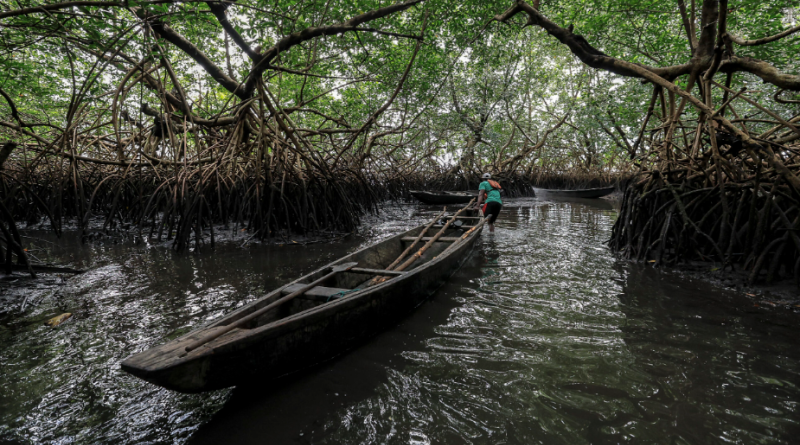
Carbon credit projects that protect or restore mangroves and other coastal ecosystems are in high demand.
As Africa seeks to develop its blue economy, one of the standout opportunities is in the area of “blue carbon”. Blue carbon project developers offer carbon credits to companies, in return for protecting or restoring coastal ecosystems, such as mangrove forests. While blue carbon is a small niche of the wider carbon market, it is in high demand for a simple reason: mangroves, along with sea-grasses and salt marshes, are extraordinarily effective as carbon sinks.
Mangroves have very deep and dense roots. This helps to trap sediment and prevent organic material releasing carbon into the atmosphere as it decomposes. In fact, mangroves can sequester carbon at a rate ten times greater than a mature tropical forest. Mangrove forests also provide a habitat where young fish shelter; and they offer protection against coastal flooding and erosion.
But mangroves are in trouble, both in Africa and around the world. A July study by Diankai Wang of East China Normal University and colleagues, for example, found that the Niger Delta lost more than a quarter of its mangroves between 1988 and 2023.
Blue carbon projects may offer one of the last opportunities to save unique coastal ecosystems. For these projects to succeed, however, developers must go far beyond conservation.
Coastal crises
Many of the threats to mangroves stem from the breakdown of economic systems that rely on coastal resources. Elizabeth Littlefield, senior partner in West Africa Blue, one of the largest blue carbon projects on the continent, highlights how coastal communities in Sierra Leone are struggling. “The economies are purely subsistence, relying on fisheries for pretty much everything. And unfortunately, over the last few decades, the fish stocks in that area have been significantly depleted, primarily through offshore commercial fishing trawlers,” she says. “Without enough fish to catch any longer, the communities have been forced to turn to harvesting mangrove wood for sale, for cooking their food, for smoking their fish and for construction.”
West Africa Blue is yet to issue carbon credits, but has already begun working with communities in Sierra Leone and Guinea to address the loss of mangroves. The project has introduced mud brick cookstoves to the area, which can be made and maintained by local people, which Littlefield says has reduced wood use per household by 60%. Fish-smoking ovens have also been brought in as an alternative to smoking fish on mangrove logs.
All blue carbon project developers recognise that success is almost totally dependent on working with coastal communities. Local people need to be incentivised to help protect mangrove forests if the carbon sequestration is to prove durable.
In practice, this means there is typically a basic three-way division between the revenues of carbon credit sales. One part goes to the developer and its investors; another slice goes to the government; and the remainder is directed towards coastal communities.
Project developer Terraformation is managing a blue carbon scheme at Keta Lagoon in Ghana. Damien Kuhn, chief forestry officer at the company, reports that 32% of revenues from the project will be channelled to a community trust fund. The board of the fund, elected by local people, then decides how the revenues are used.
“These stable income streams are, for the community, a big change-maker,” says Kuhn. He adds that the project has already created more than 720 jobs. As well as opportunities to work in planting and caring for mangrove forests, local people have livelihood opportunities through investments that allow for aquaculture to be practiced in ponds.
Of course, the benefit to the community will depend largely on the price that Terraformation can secure for the credits it issues. The company announced its first sale of credits from the Keta Lagoon project in June 2024, with UK-based property business Grosvenor paying almost $50 per tonne on average. This is far greater than typical prices for forest-based carbon credits, which hover around $15 per tonne of carbon removed from the air by reforestation and just $5 for that retained due to avoided deforestation, according to World Bank data – though prices can vary widely due to project-specific factors.
Ghana leads the way
Kuhn says Ghana proved to be “an obvious choice” as a country to launch a blue carbon credits project. “Ghana is a really positive situation,” says Kuhn. There is clear private ownership over the mangrove habitat in Keta Lagoon, he says, adding that the country has a “really clear legal framework for carbon project development. You cannot attract private investors when there is an unclear land system. To me, that’s the main bottleneck.”
Indeed, blue carbon remains nascent around Africa’s coastlines. Nigeria boasts the continent’s largest mangrove forest in the Niger Delta, yet the country has so far only seen limited investor interest in developing blue carbon projects. This reflects concern over insecurity and governance, rather than the ecological suitability of the area.
“Globally, at the moment, we’re seeing that about 5% to 10% of global carbon projects are blue carbon. When you look at that from an African perspective, it’s significantly lower,” says Reshma Shah, carbon markets lead at FSD Africa, a UK-funded financial development agency. She estimates that only 2% to 3% of carbon projects in Africa are in the blue carbon space.
FSD Africa is an investor in West Africa Blue and in a project in Kenya that aims to restore 1,500 hectares of degraded mangroves.
Shah says she is “expecting a significant increase in blue carbon projects” due to the relatively high credit prices, and the fact that impact investors can be drawn to participate in projects through blended finance structures.
Putting a price on nature
While the carbon markets are not universally popular, putting a price on ecosystems like mangroves is considered by some to be the best – and perhaps only – way to protect them. “If they have no value, then they’re going to get cut down,” says Vahid Fotuhi, CEO of Blue Forest, a blue carbon project developer. “They have no defence, and unless it’s a monetary value, no one’s incentivised.”
“Is the carbon market perfect?” Fotuhi asks. “Absolutely not. Is there room for improvement? Yes. Is it, today, the best mechanism to transfer funds to frontline communities that need the support to protect and restore those forests? Yes.”
Blue Forest is developing four projects in Africa, the largest of which is in Mozambique.
“There’s a lot of demand for these projects,” says Fotuhi. Given the limited supply at present, projects that can demonstrate their ability to sequester carbon and benefit communities, “garner attractive prices because of their scarcity,” he notes.
Littlefield, meanwhile, believes that more blue carbon credits projects in Africa will be beneficial for the market as a whole. Since few projects have issued credits so far, there is a lack of clarity on pricing.
“The biggest challenge is probably the lack of transparency in the marketplace, which I think puts a downward pressure on pricing, because people don’t totally trust it until they have some comparability.”
Ultimately, the goal for projects like West Africa Blue is not just to sequester carbon, but to foster a local blue economy. In an ideal world, coastal communities will once again flourish alongside nature.
“By restoring the mangrove forests in these areas, you create stronger and more durable habitats for those fish,” says Littlefield, “because the mangroves provide a habitat for fish and all kinds of other species, protecting and restoring them creates a self-fulfilling, positive ecological cycle.”
Cover photo: Daniel Beloumou Olomo / AFP