

Goldman Prize Winner Sarah Finch’s Lengthy Court Battle Changed Fossil Fuel Development in UK
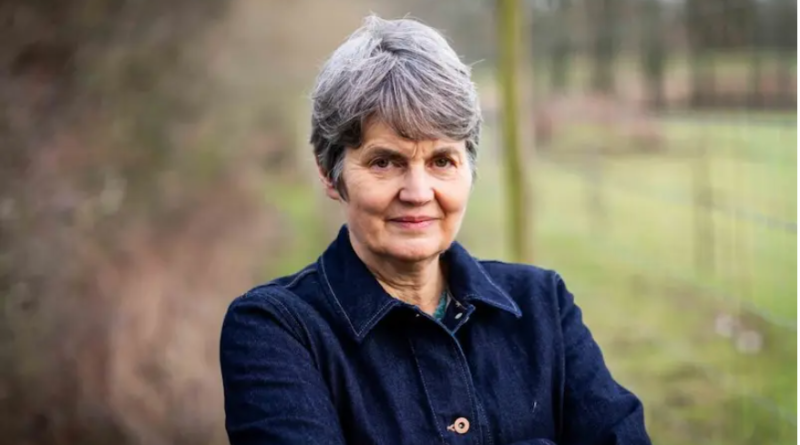
A lengthy court battle on natural gas fracking that had a seismic impact on UK fossil fuel development has won Sarah Finch one of this year’s Goldman Environmental Prizes.
Finch spearheaded the legal fight that led to a 2024 Supreme Court of the United Kingdom judgment ordering extraction to cease, on the basis that the permitting process ignored downstream climate impacts.
The judgment in Finch vs. Surrey County Council shuttered a small fracking operation in southeastern England. It also turned back three major fossil fuel development projects and led the UK government to issue new guidance for the permitting of offshore natural gas projects.
The Goldman Prize, awarded annually by the Goldman Environmental Foundation in conjunction with Earth Day, showcases the work of grassroots environmental activists from around the world. Finch is one of six winners this year.
‘You Only Care About What You Know’
Finch’s legal battle to shut down four fracking wells near her rural home in southeast England’s Weald district began in 2020 when Finch, on behalf of the Weald Action Group (WAG) and supported by Friends of the Earth, asked a local High Court to overturn a county council-issued permit allowing Hill Development Ltd. to proceed beyond exploratory drilling into full-bore extraction for at least 20 years.
The legal plea followed years of grassroots resistance by WAG, a loose consortium of neighbourhood groups opposed to fracking in the Weald. While the region had hosted small amounts of conventional oil and gas drilling for decades—it sits atop an estimated 4.4-billion-barrel shale oil reserve—extractive efforts accelerated in the second half of the decade in tandem with advances in fracking technology.
Fracking should not proceed at Horse Hill Road, Finch argued, because the project’s Environmental Impact Assessment (EIA) had failed to include the emissions that would be generated when the extracted shale oil was burned.
While the company’s EIA assessed its lifetime operational emissions at around 114,000 tonnes of CO2 equivalent (CO2e), it was silent on end use emissions that would clock in at more than 10 million tonnes.
The High Court rejected Finch’s suit, as did the Court of Appeal in November 2021.
In June 2024, however, the UK Supreme Court ruled 3-2 in Finch’s favour. The Surrey Country Council’s decision to issue Horse Hill Developments Ltd. (HHDL) a permit was “unlawful because the emissions that will occur when the oil produced is burnt as fuel are within the scope of the EIA required by law,” the court wrote.
“It is important to note that this decision does not prohibit a competent authority from granting consent to a project with significant emissions or environmental harm,” wrote the global finance firm KPMG in its analysis of the landmark judgement. What the decision did emphasize, however, is “the importance of EIAs in providing the public and the local planning authority with full and complete information about the potential impacts of a project.”
KPMG highlighted key words from the judgment saying, “You can only care about what you know about.” Those words ring on in her mind, Finch told The Energy Mix in an interview.
It’s Not the Making of the Cake That Matters
Those opposed to her suit insisted the Horse Hill fracking operation involved nothing more than “getting the oil out of the ground, out the gate, and onto a tanker”, and that downstream emissions could not be considered the extractor’s responsibility, Finch told The Mix.
“No, the burning of the oil is an inevitable impact of extraction,” she said, recalling her own and her legal team’s repeated rejoinder.
Finch said she often used the analogy of making versus eating a chocolate cake: “If you look at the impact of a chocolate cake on your diet, it’s not when you make it that affects you, it’s when you eat it.”
“To us, that was a common sense argument, and it was very frustrating in the earlier courts to hear all these lawyers, highly paid lawyers, arguing that emissions could not be connected to extraction,” she added.
“It was so validating to hear the Supreme Court read out its ruling, which was exactly what we’d said all along for five years and was self-evidently obvious.”
The impacts of the Finch ruling have extended far beyond a narrow country road in southeast England.
In September 2024, a High Court judge used it to overturn a permit for a controversial coal mine in northwest England that would have extracted 2.8 million tonnes of coal per year until 2050—generating the equivalent of roughly 220 million tonnes of carbon dioxide along the way.
Then in January 2025, another High Court judge ordered the Finch ruling to be “applied retrospectively” to overturn two major offshore oil and gas projects—the Rosebank field 80 kilometres northeast of the Shetland Islands, and the Jackdaw field 275 kilometres due east of Aberdeen.
Six months later, in June, the UK government issued new guidance to offshore oil and gas developers requiring that drilling applications contain credible assessments of all downstream emissions that would result from any proposed extraction.
‘Canada Has Some Serious Catching Up to Do’
Where the UK government now directs oil and gas developers to be up front about Scope 3 emissions, Canada is, quite literally, urging them not to bother, said Nathalie Chalifour, a law professor with the Centre for Environmental Law and Global Sustainability at the University of Ottawa.
The Strategic Assessment of Climate Change under the Impact Assessment Act “explicitly states that proponents of projects undergoing a federal impact assessment are not required to provide an estimate of the project’s downstream GHG emissions,” Chalifour told the Mix in an email.
And things have only gotten worse with the passage of the Building Canada Act, which sharply reduces oversight under the Impact Assessment Act.
“Even if the IAA required scrutiny of downstream emissions (which it does not), projects falling within the BCA would be exempt,” Chalifour wrote.
“We are in a time when decision-makers should be more (not less) informed and more deliberate and thoughtful (not less) about decisions relating to large projects that could generate significant downstream GHG emissions.”
“Canada has some serious catching up to do,” she added.
“The federal government’s own estimate of downstream emissions from Canada’s fossil fuel exports reveals just how far the country must travel, Charlie Hatt, Program Director for Ecojustice told The Mix in an email. These downstream emissions “have exceeded 1 billion MT in recent year, almost 1.5 times greater than Canada’s total domestic GHG emissions, including all GHGs from the oil and gas sector, every car and building, and all of industry,” Hatt wrote.
Both Hatt and Chalifour pointed to the International Court of Justice’s July 2025 advisory opinion on the legal obligation of states to regulate the private sector to reduce emissions as underscoring the point.
Will Starmer Keep Holding the Line?
Contained in a late November 2025 regulatory review of the UK’s nuclear industry is a recommendation to “overturn the Finch judgment for low-carbon infrastructure.”
During his Britain Built for All speech, delivered a few days later, Prime Minister Keir Starmer said he had directed Business Secretary Peter Kyle to apply all 47 of the Nuclear Regulatory Review’s recommendations “across the [UK’s] entire industrial strategy.”
In a February 21 letter on behalf of WAG, Finch urged her PM to hold the line on her namesake ruling.
Latest news is that the Starmer government is now “looking to replace the whole EIA regime with something called an ‘environmental outcomes report’,” Finch told The Mix.
“The idea is to make environmental impact assessment more focused on specific outcomes, rather than having to look at every conceivable effect of a development.”
“No details yet,” she added, on the outcome of that effort. So for now, she is reserving judgement: “It could be bad, it could be good.”
On the fate of Finch, the climate defender said she is “choosing not to be totally pessimistic.”
“I feel like we have to remain alert and defend the Finch ruling. But I also think the government doesn’t really have an appetite to get rid of it, in part because they spent a whole year writing Scope 3 emissions guidance for the offshore industry and the guidance is really good.
“For example, when the Rosebank developer came back with their new ‘Finch-compliant’ environmental statement, the government sent it back saying, ‘No, it’s not good enough; we need more information’.
“So they are holding the line.”
In the meantime, Finch and the rest of her grassroots colleague—she insists that she is merely the face of Finch, and the Goldman Prize really belongs to everyone at WAG—are focused on their next big fight: methane venting and leakage at operating drill sites, and leakage from abandoned ones.
“With all this talk of the high price of gas, the fact that methane is just being leaked into the atmosphere, I think it’s going to be intolerable to people if they know the scale of it,” Finch told The Mix.
All of which circled back to a fundamental principle that underlined the Supreme Court ruling in her case: the public’s right to know, so that people have all the knowledge required to care.
Cover photo: Sarah Finch in Surrey, England in January, 2026 (Photo: Goldman Environmental Prize)