

How Do Rooftop Solar and EVs Affect Electricity Costs for Everyone Else? Here’s a New Estimate
Researchers calculated whether solar contributes to an increase in costs for non-adopting consumers, and, if so, by how much.
One of the most divisive topics among environmental advocates and researchers is the claim that the growth of rooftop solar leads to a concerning transfer of costs from households that have solar to those that don’t.
Most people who have studied this agree there is some shift in costs, but they disagree on how much and whether it’s too much.
A recent working paper from economists at the University of Maryland offers a novel way of looking at this issue by examining how rooftop solar and electric vehicles affect electricity demand for the population as a whole, and how each contributes to changes in electricity costs for the public as a whole.
The results, I suspect, will be frustrating for solar advocates and encouraging for EV advocates. But let’s not get ahead of ourselves.
The paper was written by a team that includes Joshua Linn, who teaches economics at the University of Maryland and is a senior fellow at Resources for the Future, a think tank that studies energy and the environment. As is common for economics research, the authors are gathering feedback and will revise the paper with the aim of publishing a peer-reviewed version.
Linn and his co-authors found that adoption of rooftop solar has led to a 2.35 percent decrease in electricity utilities’ revenue, which the companies have partially recovered by increasing customer rates by 1.48 percent.
Those are small numbers. But they become more significant when the authors zoom in on the effects on low-income households without solar. The upshot is that these households experience, by far, the most significant negative effects, while high-income households have a net benefit because they gain a large share of the cost savings from using rooftop solar.
The authors found that the use of EVs helps to reduce electricity rates for all consumers, with utilities benefitting from a 0.44 percent increase in revenue and consumers a 0.23 decrease in costs.
Again, small numbers. The larger point is that rooftop solar increases costs for other consumers while EVs lower them; the size of these effects is likely to increase as market share for solar and EVs rises, according to Linn.
The analysis looks at electricity consumers as a whole, including some with solar and some with EVs, some with both, and a large majority that have neither.
“When you put solar panels on your home, you’re imposing a cost on somebody else,” Linn said in an interview.
Linn is not suggesting that the costs exceed the environmental benefits. He argues that policymakers should understand the amount of the cost shift to make informed decisions when crafting policies related to rooftop solar.
The authors make clear that their findings should be understood as short-term effects which cover two to three years. So, we cannot extrapolate the effects on rates in a decade or more.
One of my initial reactions was that the findings could be used to justify policies that support the business interests of utility companies. Utilities tend to oppose rooftop solar and want to encourage EVs, and the companies have used their lobbying power to change net metering policies in states such as California, reducing the financial benefits of solar.
Linn said he doesn’t intend to support any industry’s agenda and that this research didn’t receive any corporate funding. His larger concern, he said, was quantifying how solar and EVs affect the roughly 95 percent of consumers who have neither.
I asked John Farrell, a rooftop solar advocate and co-director of the Institute for Local Self-Relience, to read and respond to the paper. His organization views customer-owned energy resources as essential for creating a more equitable economy and counteracting the harm often done by monopoly utilities.
Farrell said that the paper’s focus on short-term effects is a serious flaw because investments in rooftop solar and other energy-saving technologies yield benefits best understood in timelines that are decades long.
“In a short timeframe, my purchase of solar panels or an energy-efficient fridge will reduce demand and (very slightly) increase the necessary rates to recover costs,” he said, in an email. “But over the lifetime of that investment, the utility can reduce supply contracts, defer transformer upgrades, etc.”
His conclusion: “Doing this study is an interesting intellectual exercise but … it loses sight of the forest for the trees.”
I wouldn’t go that far. I think we need to continually monitor how the growth in rooftop solar and EVs will affect the electricity system and the prices paid by other consumers.
It’s worth noting that the cost shifts in the paper appear small relative to the large rate increases that have happened this year as utilities upgrade their systems to accommodate data centers and other large users.
To put it another way, the cost shifts linked to rooftop solar are not near the top of my list of problems to be solved right now. But 10 years from now, following more consumer adoption, it may be a different story.
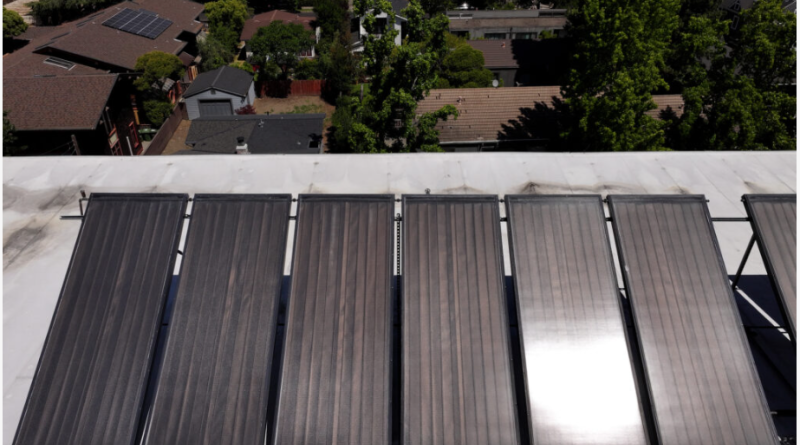
Cover photo: Solar panels are seen on the roof of a home on June 3 in San Anselmo, Calif. Credit: Justin Sullivan/Getty Images