

The Island Without Freshwater: How 400-Year-Old Roofs Solved a Modern Water Crisis (and It Has Lessons For the World)
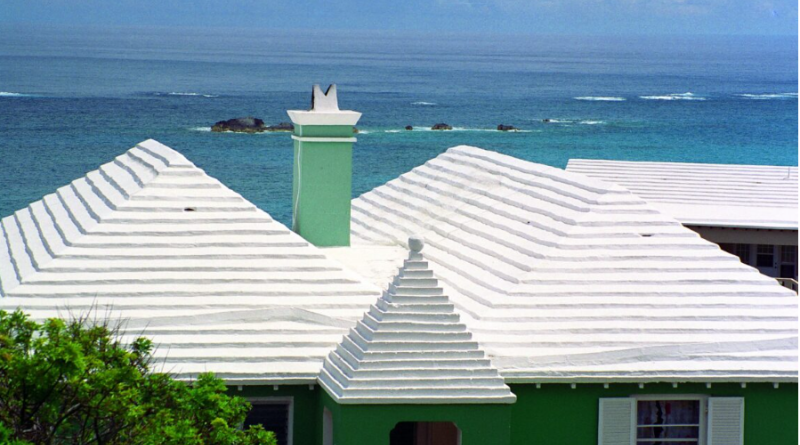
Bermuda’s limestone architecture is a masterclass in survival.
Imagine a country with no rivers, no freshwater lakes, and no springs. Now, pack 65,000 people onto it. Add half a million tourists who expect cold drinks and hot showers. Finally, put this island in the middle of the Atlantic Ocean, directly in the way of some of the world’s most violent hurricanes.
By all logical metrics, Bermuda should have died of thirst centuries ago. All the tourism in the world can’t help you if you don’t have water. But instead, it’s thriving.
They did it with a decentralized network and by turning every single building into a storage unit. And these unusual, white roofs play a key role.
If you look at Bermuda today, it’s so strikingly white and geometric that it almost looks like frosting. This is a strictly enforced survival strategy, and it could teach drought-stricken cities today quite a lot.
Undrinkable Water
The geometry of the Bermuda roof is intrinsically linked to its geology. The island is a limestone cap sitting on top of an ancient volcano. The rock is porous, so if it rains, the water vanishes instantly, filtering down through the sponge-like rock. The problem is that in the bowels of the island, this fresh, drinkable water mixes with salty groundwater lenses. You can’t drink it.
When the flagship of the Virginia Company, the Sea Venture, smashed into the reefs here in 1609, the survivors realized two things very quickly. One: the cedar trees were great for shipbuilding. Two: there was nothing to drink.
They also quickly learned that the place was very windy.
Bermuda was officially settled in 1612, and early settlers tried to build English-style cottages with thatch and wood. It didn’t work at all: the Atlantic winds shredded them. Then, they looked at the ground beneath their feet. They started using limestone and experimented with a few designs.
Then, they figured it out. A Bermuda roof is meant to do more than just cover homes. It’s supposed to slow down storms and help gather water.
First, the builders lay down limestone slates over a cedar frame. But they don’t lay them flat. They overlap them, creating a distinct, stepped profile. This helps both with slowing down winds and gathering water. When a massive Atlantic squall hits, the rain doesn’t fall straight down; it comes down at an angle and flies sideways. The steps on the roof act as speed bumps for the water, slowing down the deluge so it doesn’t overshoot the gutters.
It also disrupts wind shear. In a hurricane, smooth surfaces create lift — think of an airplane wing. If your roof is smooth, a Category 3 storm will peel it off like the lid of a sardine can. The steps on a Bermuda roof break up that airflow, pinning the structure down. It’s a limestone turtle shell, hunkered down against the elements.
But the roof is just the start. When the rain hits the stone, the water races down the steps into “glides” — stone gutters built into the walls. These glides funnel into a massive tank buried beneath the house. This is more like an excavated cavern, legally mandated to hold huge volumes of water.
The law in Bermuda is strict and has been for decades. For every square foot of roof you build, you must provide eight gallons of tank space. You are required to catch rain from 80 percent of your roof’s surface area. There is no municipal water main to save you in the rural parishes. You are your own utility company, and this is the only water source the island has access to.
If you grow up in Bermuda, you are taught the value of a cup of water before you can read. You turn the tap off while brushing your teeth not because it’s “green,” but because if you don’t, you run out of water. Rain is currency in Bermuda, where a heavy downpour is often called a “tank-filler.” In an old Bermuda home, during a storm, the pipes in the walls sing with the sound of rushing water.
Couple this with an economic lifestyle, where military showers are the norm, and that’s how Bermuda can thrive in such inhospitable settings.
A Surprise Bonus: Killing Germs
When early Bermudians painted their homes, they used lime wash, a mixture of crushed limestone, water, and sometimes whale or turtle oil. They’d slather this paste over the roof annually for waterproofing.
But this did more than just waterproof: it has antimicrobial properties.
Limestone is calcium carbonate. When it’s heated, it becomes very alkaline. When rainwater hits the roof, it dissolves small bits of the lime, raising the pH of the water. This makes the water alkaline, turning it into a natural antibacterial agent.
Modern paint has replaced the old lime wash in many places, but the principle remains. The blinding white color reflects the punishing UV radiation of the sub-tropical sun (further purifying the water via UV reflection) and keeps the house beneath it cool. It is a passive thermal regulation system that pays for itself.
The Blueprint for a Thirsty World
Bermudians are some of the most water-conscious people on the planet. In most of the developed world, we treat water as a magical right that flows from a municipal pipe, completely divorcing the user from the source. We also tend to treat water as an infinite resource, and it’s really not.
Bermudians, on the contrary, live in a permanent state of resource consciousness. They prove that when you make individuals responsible for their own survival, conservation stops being a political issue and becomes a way of living. It’s a masterclass in mindfulness. You don’t waste what you had to catch yourself. If water is endless or centralized, it’s far away and you tend not to care about it.
Beyond psychology, the island offers a blueprint for decentralized resilience. As climate change hammers centralized grids with unprecedented storms and droughts, the “big pipe” model is failing. Cities from California to Cape Town are suffering severe droughts year after year. Bermuda’s approach suggests that a distributed network of thousands of micro-reservoirs can play an important role in conservation. It’s low-tech, anti-fragile, and scalable.
But Bermuda also shows the perils that modern life brings. The tourism industry exploded in the mid-20th century. Tourists are water gluttons, and they don’t always turn off the water when they should. A hotel with 500 rooms can’t survive on roof catch. Furthermore, houses grew vertically. If you turn a single-story cottage into a three-story apartment complex, you have tripled the number of people flushing toilets, but the roof area stays the same. The math stops working.
So, Bermuda adapted.They drilled into the fresh groundwater lenses that float precariously on the saltwater table. They built desalination plants that suck in the Atlantic Ocean and push it through reverse osmosis membranes. Today, if your tank runs dry, you can call a truck to fill it with desalinated water. Around a quarter of the island’s water use comes from these plants.
But the locals view this as a defeat.
There’s a stubborn pride in the white roof because of what it represents: independence. While the rest of the world relies on centralized infrastructure, the Bermudian homeowner is self-sufficient.
This is why this 400-year-old technology matters right now. We are entering an era of water scarcity. The future of infrastructure might not be a bigger power plant or a wider aqueduct. It might look a lot like a white limestone roof, or an individual household storage unit.
Cover photo: Bermuda roof. Image via Wiki Commons.