

Looking Ahead to When Gas Stations Vanish
Leaders should plan for declining demand that will undermine the viability of fossil fuel businesses. New research says it could happen sooner than we think.
Sooner than you think, your city may be down to its last gas station, or, in large cities, the last few gas stations.
They likely will be owned or heavily subsidized by the government because few businesses can be profitable selling a product whose demand is no longer growing.
When will this happen? In regions with high penetration of electric vehicles, such as parts of California, it could be as soon as the mid-2030s.
I’m describing a near future in which electric transportation is becoming the market leader, but gasoline still has a share, albeit a declining one.
Researchers have been saying for years that leaders need to plan ahead to reduce the harm that will follow when fossil fuel supply chains are hit by resource shortages, price spikes and business failures tied to falling demand. My main question, especially in this era of “drill, baby, drill,” is whether enough people are paying attention.
A new paper in the journal Science lays out the situation. I spoke with the authors, both of the University of Notre Dame: Emily Grubert, a professor of sustainable energy policy, and Joshua Lappen, a historian and engineer. (I’ve interviewed Grubert over the years about her work on improving decision-making about energy infrastructure, and she was deputy assistant secretary for carbon management at the U.S. Department of Energy from 2021 to 2022.)
I asked how we can anticipate the timetable for when fossil fuel infrastructure will hit its downward spiral.
“It depends on which system we’re talking about,” Grubert said. “There are some systems where we’re already there.”
Grubert cites an example that’s not fossil fuels, which is the steel industry in the United Kingdom. With the closure of some of the U.K.’s final privately held steel mills, the government last year approved an emergency takeover of the final factory that produces primary steel, as part of a plan to preserve jobs and ensure there is some locally made steel to serve the country’s basic needs.
In the United States, the rising market share of EVs in some states and regions is already undercutting demand for fossil-fuel infrastructure. In California, fuel refineries are closing due to falling demand and the costs of complying with environmental regulations.
As refineries close, leaving fewer of them to serve a larger territory and ship fuel over longer distances, costs are likely to increase. This would make it more difficult for gas stations to remain viable.
“There are a lot of different factors that could lead to disproportionate closures all of the sudden at gas stations,” Lappen said. “You can’t go below a certain minimum density of gas stations.”
Some observers may scoff at the idea that the end of gas stations may be near, partly because forecasts indicate that global oil demand will increase over the next two decades. For example, the International Energy Agency said in November that it expects oil demand to increase gradually through 2050 under the “current policies scenario.”
I asked Grubert and Lappen how to reconcile the reality they see on the horizon with the idea that oil demand continues to grow.
Grubert said the models would be close to correct if the world does little additional to address climate change, but she doesn’t think that will happen.
Lappen finds fault with the ways that many energy system forecasts are constructed, including their inability to predict how and when small shifts in demand can have major effects. He thinks the continued viability of fossil fuel industries depends on steady demand to cover ongoing costs. If demand slows by much, many companies aren’t built to survive.
Lappen’s larger point is that gasoline retailers may face a cascade of challenges sooner than their operators realize. This becomes a social concern if the fueling infrastructure fades faster than the gasoline vehicle market share, leaving consumers struggling to find affordable fuel to get to their jobs and live their lives.
One easy way to misinterpret Grubert and Lappen’s paper is to say that it’s calling for the energy transition to slow down. If anything, it’s saying the opposite, calling attention to problems that occur when a new technology is rising and the old one is reluctant to leave the stage.
At the same time, U.S. policymakers and fossil fuel industries are doing just about everything they can to prolong this period. This has real costs, as can be seen in the auto industry, where companies such as General Motors and Ford must build and sell full lineups of gasoline-powered vehicles, while competitors can focus more on EVs.
When I say “gas station,” I mean a business that sells gasoline. Most gas stations are also convenience stores and make most of their revenue from selling food, drinks and other in-store products. Convenience stores will continue to exist after gasoline, whether they are gigantic destinations along highways or small outlets on street corners. But if someone needs gasoline, they may have difficulty finding it.
To gain insight into the convenience store industry’s perspective, I spoke with Jeff Lenard, vice president for media and communications at NACS, a national trade group for convenience stores and fuel retailers. He’s been with the association since the late 1990s, so he has seen decades of change in food, fuel, payment systems and other aspects of the business.
“The convenience store industry is continually under flux,” he said.
But he doesn’t think there is a danger of gasoline sales plummeting in the near future. Even if EVs were to dominate sales of new vehicles right now, he said, it would still take about two decades for the country’s vehicle fleet to entirely shift away from liquid fuels.
“That’s a long runway,” he said.
Also, the demand changes for gasoline will vary significantly across the world and within this country.
“I talked to one retailer in North Dakota, and he said, ‘If we see an EV at our lot, we are 100 percent certain that it has out-of-state plates,’” Lenard said.
As I see it, the main difference between Lenard’s view and that of Grubert and Lappen is in the length of the runway. The paper argues that even small reductions in fuel demand can cause fossil-fuel infrastructure to go awry.
My final question for Grubert and Lappen was: What advice would they give governments on preparing for a major contraction in gas stations and other fossil-fuel industries?
“First of all, I think we need to start planning for public ownership of some of these systems,” Lappen said.
Lappen’s not suggesting a government takeover of successful businesses. Instead, he’s saying that the government needs to have a plan to step in when it becomes clear that parts of fossil fuel supply chains are getting close to failing. This is essential to make sure that local economies have access to the resources they need, and to ensure an orderly wind-down as demand continues to fall.
“A lot of these systems are going to be necessary long after they’re profitable,” he said.
Grubert said a government-run system would prioritize the public good rather than rationing products or services to customers based on the ability to pay.
“So, if I’m really worried about delivering heat in the winter, that’s going to tell me something about the order and the timing with which I shut down different kinds of assets, and the order and the timing with which I build new replacement infrastructure,” she said.
When should governments begin to make plans? Ideally, they would have started already, but since that hasn’t happened to a significant extent, the answer is, “Right now.”
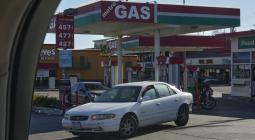
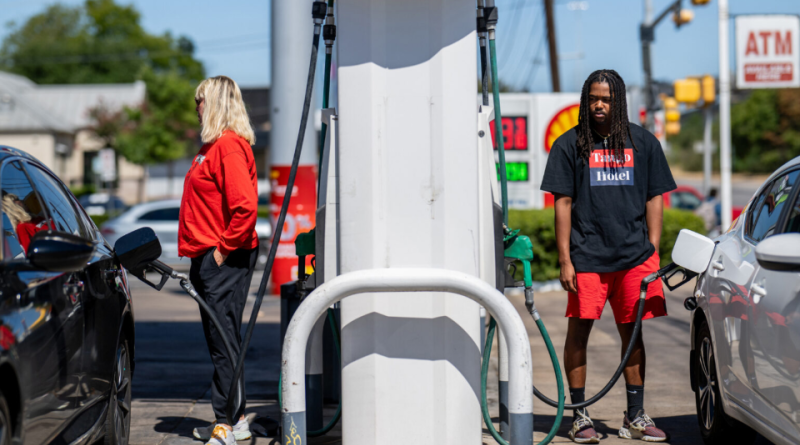
Cover photo: People pump gas at a station on Aug. 03, 2023, in Austin, Texas. Credit: Brandon Bell/Getty Images