


One centre under construction in Sydney’s Marsden Park is a 504MW datacentre spanning 20 hectares, with six four-storey buildings. The CDC centre will become the largest data campus in the southern hemisphere, the company has boasted.
In the last financial year, CDC used 95.8% renewable electricity in its operational datacentres, and the company boasts a PUE of 1.38 and a WUE of 0.01. A spokesperson for the company says it has been able to achieve this through a closed-loop cooling system that eliminates ongoing water draw, rather than relying on the traditional evaporative cooling systems.
“The closed-loop systems at CDC are filled once at the beginning of their life and operate without ongoing water draw, evaporation or waste, ensuring we are preserving water while still maintaining thermal performance,” a spokesperson says.
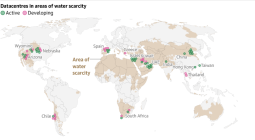
“It’s a model designed for Australia, a country shaped by drought and water stress, and built for long-term sustainability and sets an industry standard.”
Planning documents for the centre reveal that, despite CDC’s efforts, there remains some community concern over the project.
In a June letter, the acting chief executive of the western health district of New South Wales, Peter Rophail, said the development was too close to vulnerable communities, and the unprecedented scale of the development was untested and represented an unsuitable risk to western Sydney communities.
“The proposal does not provide any assurance that the operation can sufficiently adjust or mitigate environmental exposures during extreme heat weather events so as not to pose an unreasonable risk to human health,” Rophail said.