
Trump’s Grant Terminations Upheld by Fourth Circuit Court of Appeals
Still, some plaintiffs remain hopeful that they can get their funding restored by arguing that Trump’s elimination of entire grant programs approved by Congress, in areas like environmental justice, is unconstitutional.
Six cities and 13 nonprofit groups still cannot recoup millions of dollars after the Fourth Circuit Court of Appeals this week overturned a lower court’s ruling that forbade the Trump administration from terminating or freezing grant funding for environmental justice, agricultural and climate programs.
The three-judge panel—Paul Niemeyer, Allison Rushing and Toby Heyten—concluded that “the district court abused its discretion” in issuing injunctions against the administration.
Niemeyer was appointed to the bench by President George H.W. Bush; Rushing by President Donald Trump; and Heyten by President Joe Biden.
The restoration of specific grants could now be decided by the federal Court of Special Claims, which hears contract and monetary disputes with the U.S. government.
A U.S. District Court could still hear broader questions regarding the legality of the Trump administration’s elimination of entire congressionally approved programs, said Kym Meyer, senior litigation director for the Southern Environmental Law Center, which is representing several plaintiffs.
“From the outset of this case, we have been clear that executive branch agencies have no authority to cancel entire grant programs mandated by Congress. Nothing in today’s opinion alters that long-held understanding of the law and our constitutional order,” Meyer said.
The Trump administration paused or terminated the grants a year ago as part of a sweeping review and elimination of equity-related programs, including those addressing environmental injustices.
Nineteen plaintiffs, including CleanAIRE NC, the Organic Association of Kentucky and the Bronx River Alliance, sued the Trump administration last March. They argued that, since Congress had appropriated funding for the environmental and climate grants in the Inflation Reduction Act and Infrastructure Investment and Jobs Act, the administration’s actions were unconstitutional.
The plaintiffs also argued that the government’s actions were “arbitrary and capricious” and violated the Administrative Procedures Act, which dictates how federal agencies develop and issue regulations.
U.S. District Court Judge Richard Gergel of South Carolina ruled in favor of the plaintiffs in May and directed the government to immediately restore funding for 32 of 38 programs.
In June, lawyers for the administration successfully appealed to the Fourth Circuit for a stay, which put a hold on the district court’s ruling. The Appeals Court heard the case in October.
The Justice Department, representing the administration, has consistently framed the dispute as a contractual matter , not a constitutional one. The appellate judges largely agreed, writing that there is no statute requiring the government to contract specifically with the plaintiffs.
CleanAIRE NC, based in Charlotte, is among the plaintiffs. The nonprofit received a $500,000 Environmental Justice Collaborative Problem-Solving grant from the EPA in June 2024 to monitor air quality in four underserved communities in northern Mecklenburg County.
The grant would have also allowed CleanAIRE NC to train community health workers to track air quality and conduct a health impact assessment with several local health departments and North Carolina State University.
“This ruling is a deeply frustrating setback for north Mecklenburg residents who have waited decades for basic transparency about the air they breathe,” said Jeffrey Robbins, CleanAIRE NC’s executive director. “However, this is not the end of the road. While the court blocked the immediate return of individual grants, it left open a path for us to challenge the legality of the government’s wholesale cancellation of the entire grant program. Our coalition remains committed to this fight and is hopeful the courts will ultimately deliver the resources our communities were promised.”
There could be an opportunity for the 19 plaintiffs in this case to challenge the reasoning behind the Trump administration’s broad grant cancellations in federal district court.
The appellate judges cited a key U.S. Supreme Court decision published last August. In National Institutes of Health v. American Public Health Association, the Supreme Court ruled the federal district courts had no jurisdiction to hear cases about the administration’s cancellation of research-related government grants.
However, Justice Amy Coney Barrett broke from the other conservative justices on whether the government’s guidance that informed the cancellations could be challenged in traditional federal courts.
“We have clear evidence that this administration terminated not just individual grants but entire grant programs, like the Environment and Climate Justice block grant program,” Meyer said. “We look forward to following the Fourth Circuit’s direction to present this evidence to the district court, and requesting the funding be restored.”
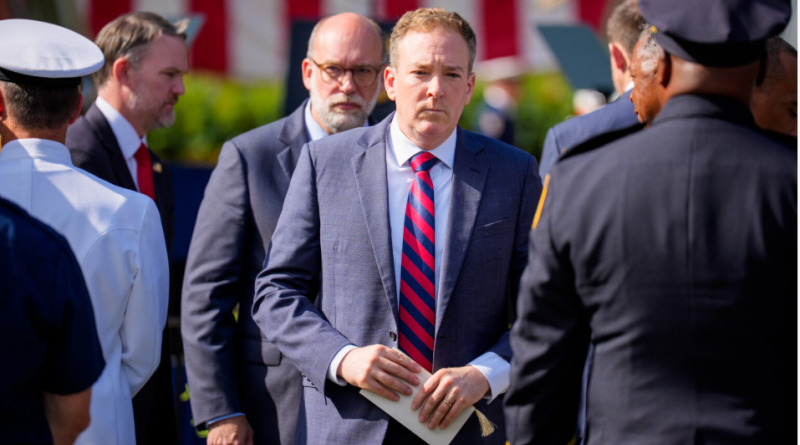
Cover photo: EPA Administrator Lee Zeldin (C) and Office of Management and Budget Director Russell Vought (L), the architects of the Trump administration's climate and environmental justice grant terminations, at a 911 ceremony in Arlington, Virginia. Credit: Andrew Harnik/Getty Images