
Trump’s Pick to Lead the Federal Reserve Could Steer Bank Away From Climate Change
Kevin Warsh has criticized central banks’ forays into climate change. Some activists and Democrats say the Fed hasn’t done enough.
The fight over control of the Federal Reserve has revolved around interest rates and inflation, but President Donald Trump’s choice to be the bank’s next chair could sway how the agency assesses climate risks, too.
In a speech last year to a group of financial leaders that was broadly critical of the Fed, Kevin Warsh called climate change a “politically charged” issue that the bank would do better to avoid.
“Central bankers and bandwagons should be strangers,” said Warsh, who has previously served on the Fed’s board and is currently a visiting fellow at Stanford University’s Hoover Institution. “It would be better for the Fed’s long-term success to focus on the time-honored and the enduring, rather than the fashionable and the fleeting. I observe the modern central bank to be a bit too willing to traffic in contraband.”
An example Warsh gave was the Fed’s joining and later withdrawal from the Network of Central Banks and Supervisors for Greening the Financial System, a group that aims to strengthen responses to climate change and includes most of the world’s major central banks. The Fed joined the group ahead of President Joe Biden’s inauguration five years ago, and withdrew right before Trump took office last January.
“Some of you might disagree with one of those options, or both of those options,” Warsh said last year. “I think the match is what bothers me perhaps most of all.”
Warsh did not immediately respond to a request for comment sent to him through the Hoover Institution.
There is broad agreement among economists that climate change is affecting the economy and poses risks to the financial system. But there’s substantial debate about whether or how that might affect the work of central banks like the Fed.
Some economists within the Fed have argued that climate change poses broad risks to financial stability. Banks could be exposed if storms or extreme weather cause widespread bankruptcies, for example. Already, insurance companies are withdrawing from some markets due to worsening wildfires and damage from coastal storms. Some research has indicated that climate change is already curtailing economic growth.
The Fed’s Board of Governors has published research on these risks.
Derek Lemoine, a professor of economics at the University of Arizona’s Eller College of Management, said this type of research should be a core piece of the Fed’s work.
“Its mandate is to maintain price stability and to maintain employment, and climate change is clearly relevant to both of those things,” Lemoine said. “So the Fed would be, in my view, violating its mandate to not at least study those things. Whether or not the study shows that it affects what the Fed does is another question.”
Many activists and some Democrats have criticized the Fed for not doing more to address climate change. The European Central Bank, in particular, has taken more steps to try to limit those risks.
In 2023, the Fed and two other agencies issued guidelines for financial institutions on assessing their own climate risks. In October, the agencies withdrew the guidelines, saying they were not necessary because existing rules required banks to examine “a range of risks, including emerging risks.”
The Trump administration has sought to roll back climate-related regulations in the financial sector more broadly. The Securities and Exchange Commission is seeking to withdraw rules that would require greater climate disclosures from publicly traded companies, and it has recently worked to make it harder for shareholders to press companies to take action on climate change and other issues.
Taken together, the moves are making the financial system less transparent and less stable, said Andrew Behar, chief executive of As You Sow, a shareholder advocacy group.
“The regulations are to reduce risk,” Behar said.
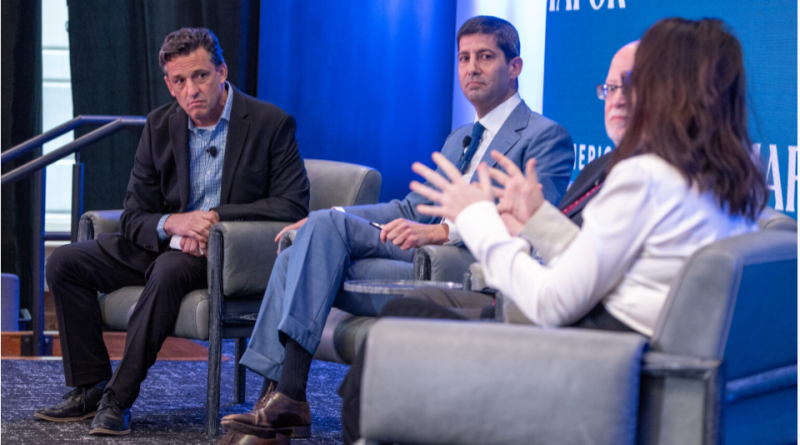
Cover photo: Kevin Warsh (center) has been nominated to lead the Federal Reserve. Credit: Tasos Katopodis/Getty Images for Semafor