

Big Oil Could Pay for Climate-Fueled Insurance Hikes
The Drain is a weekly roundup of environmental and climate news from Legal Planet.
There are several ways to try to make polluters pay. California is considering a new one — empower the state Attorney General to sue oil and gas companies to recover costs on behalf of Californians specifically related to the housing insurance market.
Survivors, taxpayers and policyholders — whose rates are skyrocketing as a result of climate-fueled disasters like last year’s Eaton and Palisades fires — are already paying. Fossil fuel companies should too. That’s the thinking behind a bill known as SB 982, or the Affordable Insurance and Recovery Act, by Sen. Scott Wiener.
Think of it as a “Make Polluters Pay to Help Stabilize the Insurance Market” bill.
The bill seeks to recover damages on behalf of policyholders and the state’s FAIR Plan (the insurer of last resort) that were caused by events that resulted from, or were made worse by, climate change. It permits the AG to bring a civil action in the name of the people against a covered entity for recovery of “climate-attributable damage.” It would create an Attorney General Climate Disaster Fund, where any monetary relief would be deposited. It would prohibit the companies from passing on the costs of the civil action by, for example, jacking up prices at the pump. Which companies should pay how much? Bill language states that “the court and jury may use market share and alternate liability principles to determine the proportionate liability of covered entities for climate-attributable damage.”
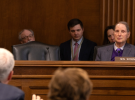
The bill got its close-up yesterday in the Senate Judiciary Committee. Environmental advocates, fire fighters, students, and lots of disaster survivors from up and down the state lined up to speak in support. The line went out the committee room and down the hall.
“The cost of home insurance has become an absolute crisis for Californians,” Wiener said in his opening remarks. “This crisis is especially acute for those who survive extreme weather events,” California Environmental Voters is cosponsoring SB 982 with the Center for Climate Integrity and Extreme Weather Survivors.
If you haven’t heard of Extreme Weather Survivors, they are a group to watch. It’s a nationwide network of people directly harmed by wildfires, floods, extreme heat, drought, hurricanes and other climate disasters. That’s a club that, sadly, grows bigger in membership every day. Like the survivors of gun violence, this is a community of people who may not share the same political beliefs (or be political at all) but who are activated to share their trauma, tell their story, and advocate for solutions. In fact, Co-founder and Co-executive Director Chris Koch previously launched the gun violence survivor network for Everytown and Moms Demand Action, as well as COVID Survivors for Change. Sierra Lindsey Kos, co-founder and co-executive director, is a filmmaker and experienced media strategist who uses storytelling to inform policy. Notably, she created a video series of human stories that explained Obamacare to the nation.
Extreme Weather Survivors showed up in full force for SB 982. A longtime resident of Altadena and retired teacher named Gayle Ali gave powerful testimony. Gayle and her husband Rasheed Ali were celebrating their 43rd wedding anniversary when the Eaton fire destroyed their home. “We are only able to rebuild because of GoFundMe, grants, and community support,” Ali said. She continued:
“What truly angers me is knowing that this wasn’t just ‘bad luck’. I’ve since learned that back in the 80s — years before we bought our home — Exxon’s own scientists warned the effects of their products would be catastrophic. They chose to hide the truth and spend millions on PR campaigns that are still running today. They could keep profiting while putting our communities in danger… Right now, survivors and taxpayers are the only ones paying for the rising cost of these disasters. Insurance company executives cite climate change when arguing for steep rate hikes. These are costs we are already paying, today. We support SB 982 because it will require oil corporations to also pay their fair share for the devastation their products helped create.”
So why focus on insurance? For one, the climate crisis is now an interwoven insurance crisis. Rates in California have risen nearly 30 percent above inflation over the last decade, with hikes as high as 150 percent in some areas, according to Wiener. The FAIR plan is seeking approval to raise rates more than 35 percent. Climate change could drive California property insurance premiums up another 41 to 88 percent by 2035, according to a new analysis from consultancy Mandala Partners. That’s not sustainable.
This bill is part of a movement. Similar efforts are underway in New York and Hawaiʻi, where lawmakers last month revived a bill that would empower insurance companies to recover losses from fossil fuel companies. These follow in the footsteps of climate superfund laws passed in Vermont and New York, which are bigger and broader.
But opposition is gathering force. As I wrote last month, Utah became the first state to try to shield oil companies from climate lawsuits in state court. Republican lawmakers have introduced similar bills in Oklahoma, Iowa, Louisiana, and Tennessee. But what the industry wants most is a legal liability shield law from Congress. The issue is coming to a head because the U.S. Supreme Court recently announced it would hear arguments about whether cities and states can sue Big Oil over its role in global warming, as former Insurance Commissioner Dave Jones notes in a recent New York Times Op Ed. “A Supreme Court ruling in favor of the oil companies in the Boulder case will probably not make all of the legal threats against Big Oil go away. But a sweeping liability waiver from Congress could — and we’d all be worse off for it.”
When it comes to SB 982, you get the feeling that the stakes are much higher than just this specific bill. This is a fight to reframe the debate over climate policy and affordability. Indeed, the non-profit California Environmental Voters has spent half a million dollars on “digital ads, guerilla marketing, print, direct mail, influencers, and amplifiers,” a spokesperson told POLITICO’s Camille von Kaenel.
“I have never seen so many listed supporters and opponents on a bill in my career here in the Legislature,” Sen. Thomas Umberg, who chairs the Judiciary Committee, said on Tuesday.
And those opponents showed up in full force too. Oil and gas business interests and allied labor groups, like the building trades unions and iron workers, voiced opposition. Their line also went out the door. A pair of expert witnesses spoke in opposition, including a partner at Altshuler Berzon LLP named Lisa Demidovich who lives in Altadena. These opponents raised concerns around due process, preemption and retroactivity. Some senators on the committee suggested that SB 982 was too similar to a broader bill introduced last year by Wiener, SB 222, which would have authorized any person to bring a civil action for damages and that the Judiciary Committee did not pass. “This bill is profoundly narrower than SB 222,” Wiener said. He indicated he was also open to making further changes to the current bill.
When it was time to vote on Tuesday, there were 6 ayes and 1 no vote and the bill was kept “on call” to hold the full vote at a later date. Several senators praised Wiener’s tenacity. I expect that the next time SB 982 is heard, the list of supporters and opponents will be just as long.
The continental United States registered its most abnormally hot month in 132 years of records, according to federal weather data. “Climate change is kicking our butts,” read the NBC headline.
The traditional April 1 water outlook from Colorado’s Climate Center puts the water equivalent in the dismal snowpack at just 22% of the historic median for the date, much lower than any year they’ve recorded under the current system, the Colorado Sun reports.
A summerlike heat wave is about to hit the East Coast. High temperature records are forecast to be neared, tied or broken in nearly 600 locations from the Plains to Northeast, worsening droughts in some spots, WaPo reports.
And a month’s worth of rain just fell on Hawai’i in two days.
Extreme weather is battering U.S. military bases “from Guam to North Carolina and fueling instability in regions overseas where American forces may be called to intervene,” Ames Alexander reports for Floodlight. Now the military under Trump is backing away from plans to protect people and bases from extreme weather.
Meanwhile, FEMA owes communities almost $10 billion, according to internal agency documents obtained by NPR. “Much of that funding would reimburse local governments for what they’ve already spent repairing infrastructure after major disasters,” Lauren Sommer reports.
Profiteering and Climate Denial
The world’s top 100 oil and gas companies collected more than $30 million every hour in unearned profit in the first month of the war on Iran, according to analysis in a Guardian story by Damian Carrington. “Saudi Aramco, Gazprom and ExxonMobil are among the biggest beneficiaries of the bonanza, meaning key opponents of climate action continue to prosper.”
Global oil supply will shrink by 1.5 million barrels per day this year, the IEA said on Tuesday, thanks to military strikes on Middle East energy assets and the effective closure of the Strait of Hormuz. Russian oil revenues nearly doubled in March.
It’s not hurting Big Oil CEOs. In the first quarter of 2026, oil executives sold more than $1.4 billion in personal stock, profiting off of US-Israeli attacks on Iran and the resulting energy crisis, the WSJ reports.
Chevron CEO Mike Wirth personally made $104 million from January to March, and ConocoPhillips’s CEO, Ryan Lance, made about $54.3 million in March, notes Emily Atkin of HEATED. “What really makes this story remarkable is not simply that oil executives got rich from a war. It’s how perfectly legal and normal it all is.”
Roughly 220 attendees cheered for EPA Administrator Lee Zeldin last week as he addressed the International Conference on Climate Change, hosted by groups that reject the overwhelming scientific consensus on climate change including the Heartland Institute. “The mood in the room was celebratory,” Maxine Joselow writes for the New York Times. “I was offered some free swag, including blue-and-green stress balls that resembled miniature Earths. The white lettering on the stress balls read: “Don’t stress. There is no climate crisis.”
A new analysis, by Lisa Friedman and Harry Stevens, of thousands of public communications by EPA administrators, including news releases, social media posts, television appearances and podcast interviews dating back three decades, shows that Zeldin has fundamentally shifted both the agency’s mission and the words he uses to describe it to reflect Trump’s desire to maximize economic development and industrial activity while downplaying environmental consequences.
The States
At least 11 states are considering legislation that would pause new data center construction, Canary Media reports.
In Maine, the legislature approved what would be the nation’s first statewide moratorium on new data centers. “Gov. Janet Mills (D), who faces a tough June primary in her Senate campaign, has not said whether she will sign the bill,” Axios reports.
In the Georgia Legislature, a handful of recent bills sought to address consumer concerns over data center expansion, but none of those bills made it to a final vote, Ryan Krugman reports for Inside Climate News.
In Texas, an exemption for the state’s booming data center industry means that the state will lose out on $3.2 billion in sales tax revenue over the next two years, the Texas Tribune reports.
In Arizona, “the clean energy team” – a slate of liberal candidates – won control of the board of the state’s largest public utility last week, reports Reis Thebault for the New Times who says the candidates emerged “from a surprisingly contentious race that attracted national attention.”
In Nevada, the largest utility could miss the state’s clean energy targets requiring 50% renewable power by 2030, Jessica Hill reports for the AP.
In Maryland, lawmakers approved a major energy bill called the Utility RELIEF Act that they hope will ease concerns about sky-high utility costs. “Consumers may not see many of the effects on their bills for months — or in some cases, years,” according to the States Newsroom.
In Virginia, a pending law will require the state’s two major vertically integrated utilities to provide detailed distribution grid utilization data to state regulators this year and propose initiatives to use more existing capacity. Democratic Gov. Abigail Spanberger has until April 13 to sign or veto the bill, but if she takes no action, it will automatically become law, writes Brian Martucci for Utility Dive.
New Jersey lifted its ban on new reactor construction. New Gov. Mikie Sherrill signed legislation “that would alter the permitting process for new nuclear power facilities to remove what the administration called a de facto moratorium on new plants,” the New Jersey Monitor reports. It’s the sixth state to do so over the past decade and the second this year, according to Canary Media.
In Ohio, Richland County banned large-scale wind and solar projects last July in 11 of its 18 townships. But as Kathiann M. Kowalski reports there’s a May referendum and every voter in Richland County will be able to weigh in on the question: Should the county keep its ban on most solar and wind farms — or scrap it and give clean energy a chance to be part of the area’s energy mix?
In Michigan and Illinois, two major housing packages are on the table that aim to curb the sprawl of single-family, detached homes in favor of denser housing development. These legislative packages “pull from a menu of land use policies that climate advocates say exemplify how lawmakers can continue to advance climate goals while working to address the most politically salient issue of the day — the cost of living,” Emily Pontecorvo reports for Heatmap News.
Back to Maine, where legislation on the cusp of passing the Legislature would direct the state’s Department of Environmental Protection to study the costs incurred by the state from the past 30 years of planet-warming emissions. It’s a “half-step” toward a climate superfund law, Adam Aton reports for E&E.
Los Angeles and California
Happy #HeatPumpWeekCA to those who celebrate! This is a critical moment in the rollout of heat pump technology, which is getting better and more popular all the time. My family loves our new heat pump, but getting it installed was complicated. Check here for incentives.
On April 3, Politico housing reporter Liam Dillon previewed his new investigative story at the UCLA Emmett Institute symposium, where he was a panelist. That story is now out: “A POLITICO analysis of local permitting data found just 34 homes have been built in Pacific Palisades and Altadena in the 15 months since the blazes, a figure that trails the rate of construction following two recent, similarly destructive fires in Northern California.”
More than 40 environmental and public interest groups are demanding that Gov. Newsom and the California Energy Commission immediately implement long-overdue rules to protect consumers from painful run-ups of gas prices at the pump. “This is exactly the type of profiteering that SBx1-2 and ABx2-1, the two special reforms that passed in 2023 and 2024, were supposed to rein in,” the groups write.
Meet the data center defender in Sacramento. Noah Baustin has an interview with Khara Boender for POLITICO’s California Climate newsletter about a raft of new bills targeting data centers. “The data center industry is committed to pay for their full cost of service for the electricity that they use and the underlying infrastructure that supports having that electricity available.”
Geothermal is moving forward in California. XGS Energy, Inc. and California Community Power, a quasi governmental agency of nine power providers, announced they inked a deal to support the development of 115 megawatts of next-generation geothermal energy in California.
AB 2748, by Assembly Member Sharon Quirk-Silva, would allow developers to follow a weaker 2022 building code that doesn’t require any EV-charging infrastructure for up to 60% of parking spaces, despite a recently implemented green building standard.
Cover photo: Evan George is Director of Communications for the UCLA Emmett Institute, a leading environmental law center