

Bin there, done that? Rethinking the recycling numbers in South Africa
Municipalities provide infrastructure for aggregation and/or separation of materials, rather than in recycling infrastructure
When it comes to waste management in South Africa, the country has developed a roadmap for research and a draft strategy is making its way through the Parliamentary process for publication in 2026.
The National Waste Management Strategy focuses on diverting waste from landfills, promotiong a circular economy and reducing waste generation. Key target include
- Landfill disposal,
- Increasing recycling, and
- Enforcing Extended Producer Responsibility (EPR) for industry to manage waste products.
-
Waste numbers and recycling
The 2018 State of Waste Report estimated that the country generated around 108 megatonne (Mt) of waste in 2017,
- with an additional 29,788 tonnes imported and
- 748,626 tonnes exported.
-
As such, in 2017, SA managed a total of 107.7 Mt of waste consisting of:
- ~55.6 Mt of general waste;
- ~52.1 Mt of hazardous waste;
-
If the ~50 MT (46% of total waste) of ash waste is excluded from the total, SA generated ~57.7 Mt of non-ash waste.
South African municipalities provide infrastructure for aggregation and/or separation of materials, rather than in recycling infrastructure. These facilities are operated by the municipality or outsourced. The country’s recycling is well supported by industry-funded associations that focus on specific materials, particular industries, or industry subsectors. Each association provides varying levels of support to its members, and some even operate as a Producer Responsibility Organisation (PRO).
-
As GreenCape’s Waste Market Intelligence Report (2022) points out, a big challenge when developing South Africa’s State of Waste Report 2018 was the lack of waste data.
“Whilst there are established mechanisms for collecting waste data, they are not fully utilised and/or enforced. Few municipalities have functional weighbridges to collect accurate disposal data for landfills, or capacity to accurately record and report the data. Despite these challenges, DFFE is confident in these estimates to inform high-level policy decisions, which in turn informs the NWMS.”
Recycling is seen as a major source of employment in South Africa, especially given that almost 90% of waste sent to landfill can be recycled in some way.
National Waste Management Strategy
The NWMS is the National Waste Management Strategy. Comments for the draft 2026 strategy closed early in 2026. It will update targets and timelines for how much waste must be diverted from landfills and recycled.
The draft NWMS 2026, meant to strengthen the circular economy framework, has the following Strategic Pillars:
- Circular Economy and Waste Minimisation;
- Effective and Sustainable Waste Services;
- Capacity Building and Awareness; and
-
The draft NWMS 2026 has also prioritised, in addition to the existing prioritised waste streams, the following waste streams:
- Absorbent Hygiene Products (AHPs);
- Organic waste;
- Clothing and textiles;
- Automobiles;
- Coal ash;
- Construction and demolition waste; and
- Food waste.
- Compliance Monitoring and Enforcement.
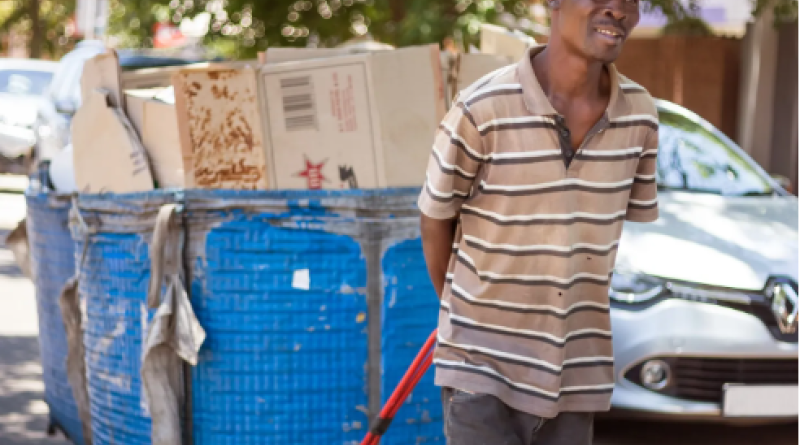
Cover photo: Waste picking in Johannesburg. Source: richtphoto©123rf