

Can Bioplastics Be Composted? UCLA Clinic Investigates
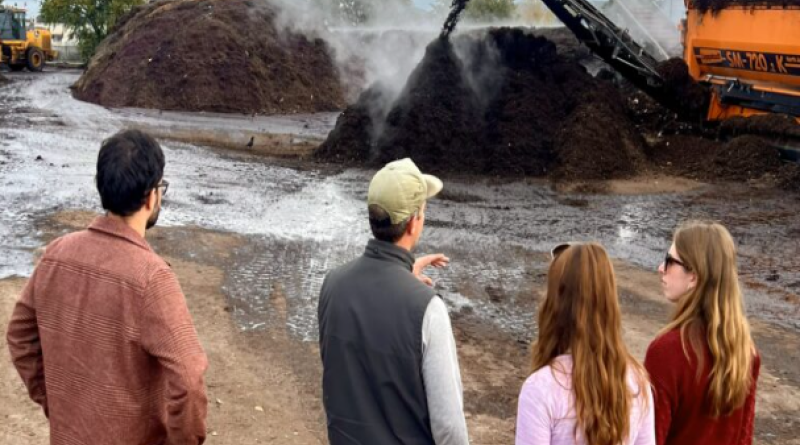
See how bioplastic packaging interacts with California’s waste system as UCLA’s Environmental Legislation Clinic tours facilities across the state.
A student team from UCLA’s California Environmental Legislation and Policy Clinic has been conducting research for a project on bioplastics through field visits at waste management sites up and down the state, from Sun Valley to Northern California. These clinic field trips have been really fascinating and a little smelly.
Clinic student Maddie Lincoln describes the project as an investigation into bioplastics and “whether they are truly helping us and the environment, or whether they are hurting us by disrupting a preexisting circular economy with respect to food waste and replacing one single-use problem with another.”
Bioplastics refers to a range of plastic products that are capable of decomposition (“biodegradable”) and in some cases are derived from a “renewable” resource, such as types of starches (“bio-based”).” One issue that the students explored is the degree to which these products actually break down during the composting process like bioplastics manufacturers claim. The students also sought to understand the extent to which these products could be recycled, rather than composted.
“While we focused primarily on composting, we explored recyclability as well,” clinic student Julianne Feuchter said. “Bioplastic is important because it will affect how SB 54, a bill that shifts waste reduction responsibility to the producer, is ultimately implemented. We looked into how bioplastics interact with the existing composting system and what changes may be needed to incorporate bioplastics into the system, or if there are insurmountable challenges to composting bioplastics that should ultimately limit bioplastics’ entry into the composting stream.”
The student team started with a visit to the state-of-the-art Sun Valley Recycling Park operated since 2020 by Waste Management (WM). The facility includes a transfer station, where WM and third-party haulers deliver waste collected from black, blue, and green trash bin routes.
There’s also a bustling materials recovery facility (called a “MRF”) that combines manual sorting with advanced optical and AI-based sorting systems to recover cardboard, paper, plastics, metals, and glass. The facility also boasts an organics processing system designed to extract and recover food and green waste for bioenergy production.
“A centerpiece of the organics operation is the Organics Extrusion Press,” said clinic student Rad Nowroozi. “It was described to us as similar to a massive industrial-scale garlic press—capable of extracting organic material while removing most contaminants which include both conventional and bio-based plastics. The resulting pulp-like mixture can then be sent to biogas processing facilities, such as the Rialto Bioenergy Facility about 50 miles east of Los Angeles, to generate renewable natural gas, which can be turned into electricity.”
During their trip to Northern California, the team visited the SSF Scavenger bioenergy facility in South San Francisco to learn about the anaerobic digestion process, which helps reduce the volume of compost that will ultimately be brought to the composter and which produces renewable natural gas to fuel their waste collection fleet.
They also visited two composting facilities: a Waste Connections facility in St. Helena that is mainly focused on composting the green waste from the wine-making process, and a Napa Recycling facility that has a broader input of all kinds of green waste as well as the digestate output that results after biogas has been extracted from green waste following the anaerobic digestion process conducted down in South San Francisco.
“Through these site visits, our students were able to witness how bioplastics are processed at multiple stages of our ‘circular economy,’ in which food and green waste is converted into natural gas and digestate that, in turn, can be composted and returned to the earth for agricultural and landscaping purposes,” said Brennon Mendez, the Emmett/Frankel Fellow at UCLA Law who co-taught the legislation clinic this year with our Deputy Director Julia Stein. “The students gathered on-the-ground knowledge of the composting process, which will then inform their policy recommendations to the state legislators that are partnering with our Clinic this legislative session.”
UCLA’s California Environmental Legislation and Policy Clinic gives students a unique, hands-on opportunity to experience the legislative process in California through direct work on cutting-edge issues. Clinic students work with legislative staffers, engage with advocates and interview stakeholders. Research projects often turn into draft legislation. “Ideally, these site visits will result in public policy that achieves California’s ambitious pro-environmental goals while remaining attuned to the practicalities and challenges of modernizing our waste management system,” Mendez said.
“A primary goal of these visits was to see for ourselves how bioplastics are actually being treated in the waste stream and how composters view them,” Lincoln said.
“While we can read articles and talk to stakeholders over Zoom calls, it felt important to have a thorough understanding of how these waste processes truly work before making recommendations to California senators that could have an immense impact on waste haulers and composters,” Feuchter said.
“I think the site visits complement the clinic’s “learn by doing” approach really well. Seeing these processes on the ground has strengthened our ability to offer thoughtful, effective policy recommendations to our partners in the Legislature,” Nowroozi said.
The team’s research is ongoing and is informing discussions around a legislative proposal in 2026.
Cover photo: By legal planet