
Grid feeding vs grid forming: Understanding the control philosophies shaping modern power systems
As power systems transition from synchronous, inertia-rich generation to inverter-based resources (IBRs) such as solar PV, wind and battery storage, the way these resources interact with the grid has become a defining technical and commercial issue.
At the centre of this shift are two distinct operating philosophies: grid feeding (grid-following) and grid forming.
To understand the difference between the two, you must examine the mechanisms, behaviour, advantages and limitations of each approach, and explore how utilities, developers and system operators deploy them in practice.
Defining the control philosophies
The fundamental distinction between the two technologies lies in who establishes the grid conditions—specifically, voltage and frequency—and who simply responds to them.
- Grid feeding (grid-following): These inverters measure the existing grid voltage and frequency to synchronise their output, injecting current accordingly.
- Grid forming: These inverters act as a reference for the grid by autonomously establishing and regulating voltage and frequency.
Core mechanisms and behaviour
The operational differences stem from how each system interacts with the electrical environment.
Grid-feeding mechanisms
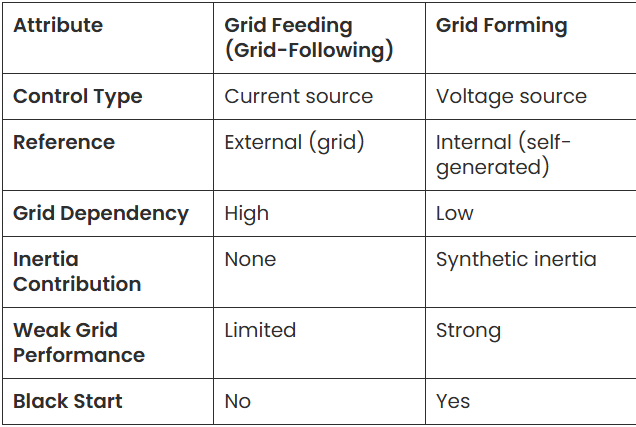
Grid-following inverters operate as current sources. They utilise a Phase-locked loop (PLL) to continuously track the grid’s voltage angle and frequency, adjusting their active (P) and reactive (Q) power injection based on these external setpoints.
Because they require a stable external voltage waveform to function, they are highly dependent on grid strength; if the grid signal becomes unstable or disappears, the inverter may lose its reference and trip offline.
Grid-forming mechanisms
In contrast, grid-forming inverters behave as voltage sources. Using advanced algorithms like droop control and Virtual Synchronous Machine (VSM) technology, they mimic the inertia and damping behaviour of traditional synchronous generators.
They do not wait for a grid signal; instead, they create an internal voltage phasor to set the local frequency and magnitude. This allows them to operate in weak grids, support islanded systems, and even provide black-start capabilities.
Key differences at a glance
Pros and cons for the energy market
Grid feeding
- Pros: This is a mature, widely deployed technology with a lower cost and simpler control architecture. It offers fast, precise power control when connected to robust grids.
- Cons: It cannot provide inertia or system strength and is prone to instability at high levels of renewable penetration. It is effectively useless for blackout recovery or islanded operation.
Grid forming
- Pros: It enhances resilience by providing voltage control, synthetic inertia and ancillary services. It is essential for stabilising weak or renewable-dominated grids.
- Cons: The technology requires more complex control designs, greater engineering effort and higher initial costs. Interoperability standards are still evolving, requiring careful coordination with existing protection systems.
Tools, products, and services
The ecosystem for managing these technologies is diverse, involving specialised hardware and analytical services.
- Grid-feeding ecosystem: Includes standard utility-scale PV inverters, wind turbine converters and EV charging infrastructure. Management services focus on PLL tuning, grid compliance studies and SCADA-based dispatch.
- Grid-forming ecosystem: Centred around Battery Energy Storage Systems (BESS) with GFM firmware, as well as advanced STATCOM and HVDC systems. Supporting these requires Electromagnetic Transient (EMT) modelling, system strength studies and specialised microgrid control systems.
Current applications and examples
Grid-following remains the global backbone, currently used in most utility-scale solar plants and wind farms where the grid is still rich in traditional inertia.
Grid-forming is being deployed where traditional assumptions of grid stability no longer hold. Key use cases include:
- Microgrids in remote regions or island systems.
- Weak grids in parts of Australia and Africa, where system strength is low.
- Black-start services, where BESS units are replacing thermal plants to restore power after a blackout.
The emerging paradigm
Grid-following inverters enabled the first wave of renewable integration. But as systems decarbonise and inertia declines, they are no longer sufficient on their own.
Grid-forming technology represents a structural shift—from passive participation in the grid to active creation of it.
The future of the power system is therefore not a binary choice between the two. Instead, the industry is moving toward a coordinated model where grid-forming units provide the “grid backbone” (stability and frequency), while grid-following units provide efficient, scalable bulk energy injection.
As systems continue to decarbonise, finding the optimal mix of these technologies is the next major challenge for utilities, developers, regulators and policymakers.
Cover photo: romanzaiets/123rf.com