

It’s Not the Generation
Abandoning low cost renewable energy generation is not the solution to electricity affordability
The Wall Street Journal Editorial Board should not be your first stop for unbiased opinion on the state of energy policy in California. Nevertheless, I could not stop myself from reading Wednesday’s Op-Ed, California’s Stranded Solar Assets, about the ongoing saga of the Ivanpah solar thermal project, a 386 MW power plant near the California/Nevada border that began operation in 2014. The Op-Ed contributes to an ongoing fiction from the Trump administration and others that the reason electricity costs are high is because liberal bastions like California insist on overpaying for energy generation from solar and wind. However, neither the Op-Ed nor the Trump Administration tend to mention that utility-scale photovoltaic (PV) solar has been the cheapest form of electricity in human history since about 2020.
The narrative put forward about the high cost of renewable energy as the primary cause of rate increases is just not true. Generation is always an important piece when looking at affordability, but it’s not the main story, at least not in the past ten plus years. To the contrary, as a recent study by Lawrence Berkeley National Labs showed, utility expenditures on generation actually declined in real terms across the U.S. since 2005. Over the same period, spending on distribution and transmission increased substantially, especially for capital spending on distribution (i.e. the local “poles and wires” grid).
Nevertheless, the story that boondoggle spending on solar and wind is the main culprit behind electricity price increases keeps being told. It’s a particularly pernicious narrative because it kind of sounds like it should be right. After all, electricity rates in California are high, and everyone knows that California has long been at the forefront of requiring utilities to purchase renewable energy. California Senate Bill 1078 established the Renewable Portfolio Standard (RPS) back in 2002 and required utilities to increase their procurement of renewable energy resources by at least 1% per year until they hit 20% by 2017. (Subsequent laws both accelerated and increased the RPS.)
So the Wall Street Journal Editorial Board and the Trump Administration would have you believe that you simply have to put those two things together: large increases in electricity rates + a mandate to buy renewable energy = solar is to blame.
Another reason the story is hard to shake is because it points to a real problem, but then misdiagnoses the cause of the problem.
The Real Problem:
Average residential rates for electric utility customers in California are high. (Approx. 35-45 ¢/kwh.) California has long prided itself on its low per-capita energy use, meaning rates might be high but overall bills are moderate, but that story is cold comfort these days as rates have increased substantially in recent years. Southern California Edison and PG&E residential average rates increased 41% and 38%, respectively, since January 2022. These increases are very real, and they are significantly contributing to the affordability crisis in California.
The Misdiagnosis:
The California Public Utilities Commission’s annual SB 695 Report and the Berkeley Labs report I mentioned above point to three main drivers for the increase in average residential rates for investor owned utility customers in California over the past five years (retail price increase estimates are from Berkeley Labs):
- wildfire related mitigation and liability costs (4.3¢);
- increased distribution (and transmission) spending (3.7¢); and
- net-metering cost shifting (i.e. rooftop solar rate design) (2.5¢).
If California is going to get a handle on high electricity rates, it’s going to be because we find a way to solve the dual problem of needing to invest billions of dollars in much-needed grid infrastructure (particularly in the distribution system) while simultaneously contending with increasing climate catastrophe costs. Whatever the solution is, it’s going to rely on a whole lot of solar generation because solar is cheap.
The Time Warp:
Now we come back to the Ivanpah solar project because there is again a kernel of truth in the Wall Street Journal Op-Ed: Ivanpah is really expensive. However, it’s expensive because it was built with a different solar technology at a time when most solar projects were still relatively expensive. The Trump Administration and other critics of renewable energy today are stuck in that world of 15 years ago. They are asserting incorrect facts about the costs of solar and wind because they are relying on outdated assumptions.
The California Energy Commission (CEC) approved the Ivanpah Solar Electric Generating System in September 2010. The plant is a solar thermal “power tower” that uses a series of mirrors spread out in the desert near the California/Nevada border on the way to Las Vegas to focus sunlight to a central tower. The sunlight heats up the tower, which creates steam, which drives a turbine, which generates electricity. It’s more or less the same concept as lighting rocks on fire to heat water, which creates steam, etc.
Ivanpah was one of a series of proposed utility scale solar projects that sought funding and fast track approval following the Obama-era American Recovery and Reinvestment Act (ARRA). I remember the projects well because I was tasked with challenging another of the large solar projects, the Calico Solar project near Barstow, right after I was hired by the Sierra Club in 2010. I’m no fan of Ivanpah. It was devastating to the endangered desert tortoise population, and the Calico project would have been even worse.
Ivanpah made it through, and Calico didn’t. Specific prices from the utility power purchase agreements are confidential, but Calico and Ivanpah were likely in the range of $110–$140/MWh. Compared to costs today, that is expensive power, and that’s precisely the point.
The Calico project ultimately failed because it relied on relatively expensive solar thermal technology. Right around this time period in 2010, the cost of PV solar plummeted. Calico actually tried to pivot mid-stream away from solar thermal and make it a PV project, but it didn’t work out. (It didn’t help that Sierra Club and Defenders of Wildlife succeeded in convincing the CEC to avoid the most sensitive habitat by reducing the size of the project from 8,200 to 4,600 acres.) Ivanpah, along with the Abengoa and Genesis projects, made it through before everyone realized that PV was going to be the cheaper way to go.
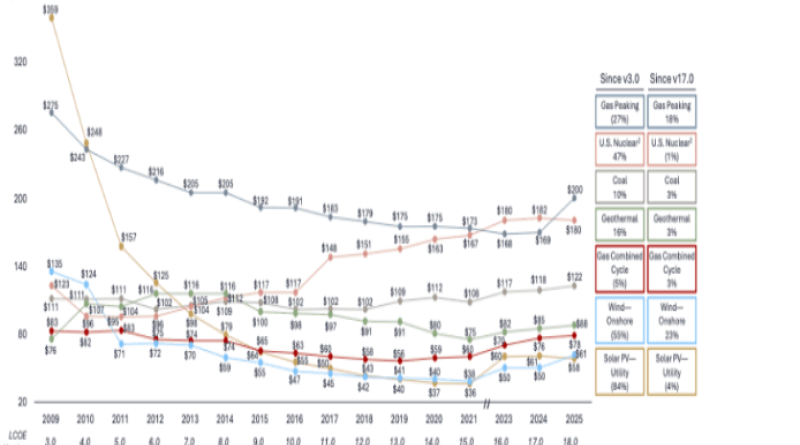
Lazard’s Levelized Cost of Energy (LCOE) 2025 Report has a great graph showing this change. From 2009 to 2025, the average LCOE for Solar PV dropped 84% from $359/MWh to $58/MWh. At its low point in 2021, Solar PV was only $36/MWh. For comparison, coal during the same period rose from $111 to $121/MWh, a 10% increase.
Solar thermal and solar PV are very different technologies. Solar thermal projects like Ivanpah rely on the sun to heat up liquid, similar to older technologies like gas and coal, though without the detrimental emissions from fossil combustion. PV panels, on the other hand, are made up of photovoltaic cells that directly convert light to electricity. I tried to find a historical chart showing the change of solar thermal costs over time, but there just isn’t enough data because the technology never really took off. The best I could find is another Lazard chart from 2013 that shows the relative levelized costs of various generating sources.
This chart shows a snapshot in 2013, where the costs of solar thermal ranged from $125 to $164, right around where Ivanpah sits. Solar PV, at around $98 in 2013, is already on its way down at this point, with much farther to fall in the coming years.
It’s Not the Generation Costs
So where does that leave us? In 2010, Ivanpah was expensive, but it wasn’t that far off from the cost of coal or nuclear power. Moreover, it was an investment by California in a technology that looked promising as a means of producing carbon free electricity. Even the Wall Street Journal Op-Ed concedes, perhaps inadvertently, that Ivanpah’s technology was “embryonic.” The whole idea at the time was to invest in the RPS in order to create a market that drove down prices. That’s exactly what happened, except that PV was the winner over solar thermal. California’s early investments in renewable energy included power purchase agreements that are above today’s market prices, but those investments helped drive an industry that has given us the cheapest electricity in the history of human civilization.
The Wall Street Journal Op-Ed argues that California isn’t letting go of Ivanpah because of climate ideology. But if you actually read the CPUC Resolution recommending rejection of PG&E’s request to drop Ivanpah, you may notice two things. First, part of the rationale the CPUC gives for holding on to Ivanpah’s clean generation is that the chaos and uncertainty of Trump’s tariffs and energy policies mean that they aren’t so sure the site would be allowed to be redeveloped with lower cost solar PV. As a result, they worry both about resource adequacy and that a lot of transmission capacity reaching the remote location would be stranded. Ratepayers are still on the hook for those infrastructure costs even if the Ivanpah power contract ends, and the CPUC determined the stranded costs outweigh the benefits.
Someday the Ivanpah contract will roll off the books, as will other 20 year power purchase agreements that are expensive relative to today’s prices. That turnover will help alleviate rate pressure, especially if we replace the generation with low cost solar and wind. But blocking wind projects and mandating the operation of out-of-the-money coal plants is not the path to affordable electricity rates.
Generation is not the main problem today precisely because the costs of renewables like PV solar have dropped so substantially over the last decade. So let’s get to work on figuring out how to deal with wildfire costs and distribution grid investments, where the real challenges lie.
Cover photo: From LCOE Report