

Pace of Global Warming Nearly Double Since 2015 While Heat and Drought Combine More Often
The pace of global warming has nearly doubled since 2015, the year the Paris climate agreement was adopted, and the atmosphere is on track to push permanently past the threshold of 1.5°C average warming before 2030, concludes a new study in the journal Geophysical Research Letters.
That trajectory will be decided by how quickly climate pollution from fossil fuels is brought to zero, one of the study authors says.
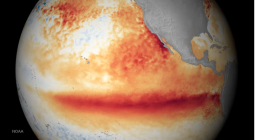
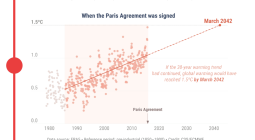
By isolating human-driven warming from natural influences like the El Niño phenomenon, the study team determined “that the world had been warming at a rate of around 0.2°C per decade since the 1970s, but has ‘accelerated’ since 2015 to a rate of 0.35°C per decade,” Carbon Brief reports.
“The essential result of this paper isn’t how fast we’re warming, but that warming is now happening faster than before and that the difference isn’t negligible,” said study co-author Dr. Grant Foster, now retired from the consulting firm Tempo Analytics.
Scientists generally interpret long-term global warming over a 20-year span, so temperature rise that exceeds 1.5°C in a single year is not considered to breach the Paris accord, Carbon Brief explains. But after filtering out the naturally-occurring “noise” from El Niño and La Niña, volcanic activity, and variations in solar activity, “acceleration is easy to prove statistically—some might even say it becomes obvious,” Foster said.
Carbon Brief goes long on the detailed methodology behind the study, and on past research to test whether warming is speeding up.
“The findings shed light on an ongoing debate among researchers,” Bloomberg News reports. “While there is consensus that greenhouse gas emissions have caused the planet to heat up since pre-industrial times, that warming had been steady for decades. But record-breaking temperatures in recent years have led scientists to question whether the pace of temperature gains is accelerating.”
The new research shows that “if the warming rate of the past 10 years continues, it would lead to a long-term exceedance of the 1.5°C limit of the Paris Agreement before 2030,” co-author Stefan Rahmstorf, a researcher at Germany’s Potsdam Institute for Climate Impact Research, told Bloomberg. “How quickly the Earth continues to warm ultimately depends on how rapidly we reduce global CO2 emissions from fossil fuels to zero.”
Meanwhile, a separate study finds that compound drought and heat events (CDHEs), where the two forms of extreme weather occur in tandem, have “surged” around the world since the early 2000s, with the global area affected more than doubling between 1980-2001 and 2002-23. The study in the journal Science Advances concludes that the combined events within a single region “are often triggered by large-scale weather patterns, such as ‘blocking’ highs, which can produce ‘prolonged’ hot and dry conditions,” Carbon Brief writes.
Global warming isn’t the sole cause of the increase in CDHEs over the last 23 years: “Since the late 1990s, feedbacks between the land and the atmosphere have become stronger, making heat waves more likely to trigger drought conditions,” the news story states.
When the occur together, “the two hazards reinforce each other through land-atmosphere interactions,” said study author Prof. Sang-Wook Yeh of Ewha Womans University in Seoul. “This amplifies surface heating and soil moisture deficits, making compound events more intense and damaging than single hazards.”
CDHE’s have taken place most frequently in northern South America, Eastern Europe, Central Africa, South Asia, and the southern United States, the study found.
Cover photo: Free-Photos/Pixabay