Trump’s pardon of an ex-Honduran president is shocking. So is the history of US support for him
Obama, Trump, and Biden stood by their man in Tegucigalpa for the eight vicious, destructive years he was in power
Since President Trump first announced the pardon of former Honduran president Juan Orlando Hernández last Friday, the media has been wading through the long list of criminal acts that led to Hernández’s 2024 conviction for drug trafficking, money laundering and arms dealing. Trump’s outrageous pardon is being contrasted with his unlawful, aggressive attacks on boats allegedly trafficking drugs for the government of Venezuela. Missing from the narrative, though, are the other illegal acts committed by Hernández that weren’t about drug trafficking, and thus didn’t fall under the justice department’s anti-drug mandate when it charged and convicted him in the southern district of New York. Many are the crimes of Juan Orlando Hernández, and ruinous.
And long is the history of US support for him in full knowledge of those crimes. Presidents Obama, Trump and Biden all stood by their man in Honduras for the eight vicious, destructive years he was in power. They ignored his drug connections, supported the military and police that kept him in power through state terror, and countenanced his illegal re-elections. Hernández was only able to rise to power, and stay there, because of the United States government.
When Hernández was a member of congress he was part of a committee that approved the 2009 military coup that deposed the democratically elected president Manuel Zelaya. As president of congress in 2012, he led the “technical coup” in which four out of five members of the constitutional branch of the supreme court were illegally and replaced with his loyalists. Hernández won the presidency in a dubious 2013 election. Two years later it was revealed that he and his party stole as much as $300m from the national health service to pay for their campaigns, bankrupting it. Under his watch, the criminal justice system crumbled; gangs, violence, extortion and murder proliferated.
In 2017, Hernández ran for re-election even though the constitution strictly forbade it. When the majority of the results had been counted in that election and his opponent was clearly ahead, Hernández’s officials shut down the computers, then announced a week later that he had won by 1.7%. In response, outraged Hondurans peacefully protested and Hernández’s security forces used live bullets for the first time in decades, killing at least 20 protesters and bystanders.
All those years Hernández was also in bed with drug traffickers. As the brave prosecutors of the southern district of New York (SDNY) have shown, he accepted huge sums from drug traffickers, including a million dollars from the famous Mexican cartel leader Joaquín “El Chapo” Guzmán. Memorably, Hernández promised to “shove the drugs right up the gringos’ noses”.
But when Hernández overthrew the supreme court in 2012, the US government looked the other way. When widespread violence erupted in the run-up to the 2013 election that Hernández falsely claimed to have won, and a recount was barred, Obama’s secretary of state, John Kerry, blessed the outcome and praised the Honduran government “for ensuring that the electoral process was generally transparent, peaceful, and reflected the will of the Honduran people”. When Hernández ran for re-election in 2016 in complete violation of the Honduran constitution, the US embassy in Tegucigalpa announced: “The United States does not oppose President Hernández or others from presenting themselves for re-election according to Honduran democratic practices.”
And when Hernández went on to steal the 2017 election, the state department, under Trump, congratulated him on his victory.
In 2015, hundreds of thousands of people erupted in peaceful anti-corruption demonstrations demanding “FUERA JOH!” (Hernández Out!). Days after the biggest single march in the capital, the US ambassador, James Nealon, stood next to Hernández in a matching guayabera shirt at the embassy’s big Fourth of July party and announced very deliberately: “Relations between the United States and Honduras are perhaps the best in history.” Soon after, Biden, then the vice-president, launched the “Central American Alliance for Prosperity”, rushing $250m to aid the Honduran government.
During all these years the US also poured tens of millions of dollars into the support of the Honduran military and police, shared intelligence with its military, and worked closely with figures now documented to have been collaborating with drug traffickers. Former general Julián Pacheco Tinoco, minister of security under Hernández, for example, was named explicitly during Hernández’s trial. It’s implausible to think the US wasn’t well aware of Hernández’s narco connections all these years, given its vast intelligence apparatus including the CIA, the Defense Intelligence Agency and the Drug Enforcement Administration.
Yet in 2017, Gen John Kelly, former head of the United States Southern Command and about to become Trump’s chief of staff, referred to Hernández as a “good friend” and a “great guy”. Adm Craig Faller, head of the United States Southern Command, after presenting a medal in December 2020 to the chief of Hernández’s armed forces in December 2020 announced: “Honduras is a trusted partner in regional efforts to combat illicit traffickers.” Beginning in 2015, 80 Members of Congress and a dozen senators demanded that the US suspend all security aid to Honduras, but Obama, Trump and Biden kept the money flowing nonetheless.
Thanks to Trump’s shocking pardon, Hernández’s drug crimes are now more well known than ever. But the rest of his repressive, thieving, dictatorial history, backed by the United States year after year, has evaporated from the story. Who will be held accountable up north for supporting him all those years, in yet another chapter of repressive US intervention in Latin America? Or will Hernández’s full criminal history – and US support for him – be swiftly forgotten?
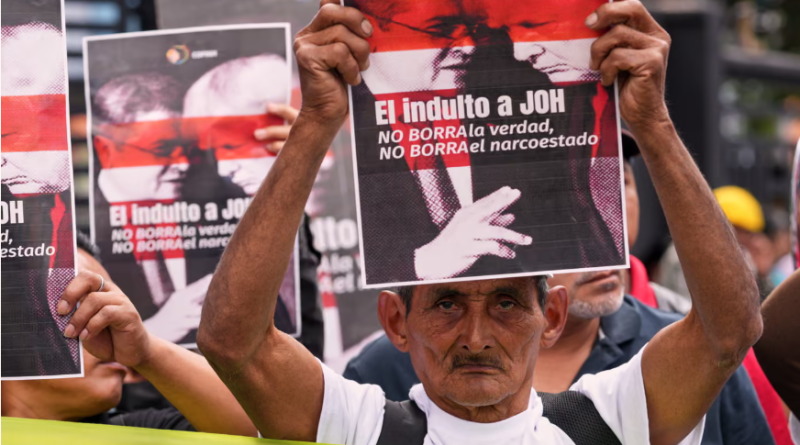
Cover photo: ‘When Hernández overthrew the supreme court in 2012, the US government looked the other way.’ Photograph: Moisés Castillo/AP