

With Waters Rising, Pennsylvania’s Historical Treasures Must ‘Adapt or Collapse’
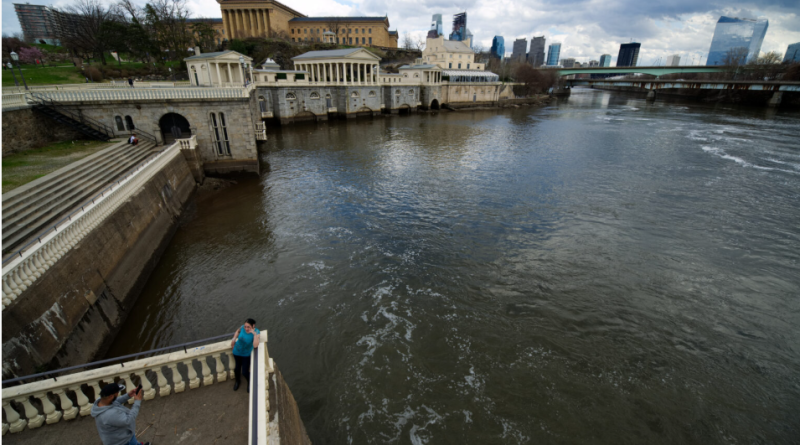
As climate change supercharges floods and rainfall, the state’s water-adjacent landmarks are especially vulnerable.
PHILADELPHIA—Karen Young stood in a cavernous room perched on the edge of the Schuylkill River that was once a public swimming pool.
Abandoned in 1972 after a hurricane, the old natatorium is part of the Fairmount Water Works, an interpretive center and event venue housed in a 200-year-old structure that powered Philadelphia’s municipal water system for almost a century. The room is trapped in time: The paint is peeling, rust crawls across the ceiling and the bleachers sit empty next to the pool’s drained basin.
As sunlight rippled off the river, dappling the mottled walls, Young thought about the night more than five years ago when another hurricane threatened the Water Works, a National Historic Landmark. The executive director of the Water Works since 2007, she’d confronted flooding before. But she had never seen anything like Hurricane Ida.
Ida dumped between five and 10 inches of rain on southeastern Pennsylvania, much of it within a matter of hours. The Schuylkill River crested at 16.35 feet, just shy of the historical 17-foot record.
“The force of the water blew out doors. It blew out windows,” Young said. “Anything that wasn’t removed from the building was subject to floodwaters.” The storm destroyed the elevator and sprinkler system as the water reached the ceiling. Several inches of unsanitary debris and muck were left behind. The center shuttered for more than six months.
According to the Philadelphia Water Department, Pennsylvania endures the most flooding of any state, posing serious risks to homes, businesses and infrastructure along 86,000 miles of rivers and streams. It’s also a hazard to the state’s many beloved historical sites. Pennsylvania ranks third in the nation for the number of National Historic Landmarks within its borders; Philadelphia alone has 65.
Because they were built directly on waterways, some of these places are uniquely vulnerable. As climate change intensifies and makes severe weather more frequent, that danger is reaching new heights.
In the past, climate adaptation was considered something “nice to have” for historical sites, said Seri Worden, senior director of preservation programs at the National Trust for Historic Preservation. “Now it’s becoming a critical, absolute need.”
Without adequate preparation at these sites for climate change, she said, “we just might not have them anymore. They might be gone.”
Building Resilience
The night Hurricane Ida hit in September 2021, the Water Works was scheduled to celebrate the opening of an exhibit in the natatorium about the history of segregation and discrimination in public pools. Hundreds were expected to attend the reception outside.
As staffers were setting up, cell phone alarms warning of the approaching storm went off. It was hard to know how seriously to take the alerts, Young said, and they wasted precious time trying to decide what to do. Eventually, the center had to be evacuated, the exhibits hastily dismantled and moved to higher ground.
The damage from Ida is still visible at the Water Works today. Temporary wood paneling covers doorways that have not yet been repaired, and staff use space heaters to stay warm in the winter. There is rust on the legs of some of the exhibits, remnants of the flood. Wiggly blue stickers with Ida written on them are taped around the center, marking the high points of the flood: in the stairwell, on the wall, on a column just below the ceiling.
Even years later, Young and her staff are always waiting for another Ida to hit, for the water to keep rising. “So every time it rains around here? Yeah, there’s nothing but tension.” She drew her shoulders to her ears. “It feels like we all have PTSD from experiencing this amount of flooding.”
As traumatic as it was, Young has come to see Ida as a learning opportunity. “It’s a way for us to think through how to save these buildings, because that’s the paramount goal,” she said. “If we don’t adapt, we just lose the buildings. And that’s not something any of us want to see happen. It’s either adapt or collapse.”
The Water Works has a three-phase plan to protect the site from future floods, but it is still in phase one. Exhibits are set up on wheels or hung from winches, so they can be easily removed or lifted during an emergency. Interactive screens pop out of their frames.
They don’t use paper for educational resources anymore, and the exhibits are made of steel and other materials that can withstand water. The complex was designed for water to flow through it, so the staff doesn’t try to fight that inclination. During a flood, they open the doors. “Eventually, the water will recede, so let’s give it a place to go,” Young said.
“If we don’t adapt, we just lose the buildings. And that’s not something any of us want to see happen.”
— Karen Young, Fairmount Water Works executive director
Claire Donato, architect with Mark B. Thompson Associates, has been part of the Water Works’ story since the 1990s. Back then, the mission was to restore the Water Works to its former glory after years of neglect following Hurricane Agnes. Its location and Agnes’ destruction meant that protecting the building from floods was always part of the restoration effort, she said. The original opening of the interpretive center in 2003 was delayed because of flooding. But at the time, they never imagined a storm as destructive as Agnes could happen again.
Ida forced them to reconsider what would be necessary in a future of unprecedented weather.
“When we got to Hurricane Ida, it was as catastrophic as Agnes, and then we realized that we really need to rethink and add more resiliency features going forward,” Donato said.
The Paradox of Water
Frank Lloyd Wright’s Fallingwater is facing some of the same problems that the Water Works must navigate. The iconic modernist house sits on a stream called Bear Run in western Pennsylvania’s Laurel Highlands; it was built here because of the stream, the architecture meant to evoke and echo the forest and water around it. This UNESCO World Heritage site has also been threatened by that intimate proximity: Floods in 1955 and 2017 caused major damage.
“The stream is itself the main inspiration for the building. The architecture is meant to be this structural cascade, mimicking the idea of rushing water through the landscape,” said Justin Gunther, the director of Fallingwater. “So the very thing that inspired the architecture is also viewed as potentially its main enemy in many ways.”
In 2024, the Western Pennsylvania Conservancy, the nonprofit that owns Fallingwater, embarked on an ambitious preservation project to protect the house for future generations. It’s not just flash flooding that has to be considered; the conservancy must account for the slow destruction caused by repeated rainfall, moisture infiltration and temperature cycles.
Fallingwater’s preservation efforts include keeping the area upstream of the site clear of debris and investing heavily in the health of the acres of surrounding forest. Fortifying the house’s roof and concrete structure also requires careful maintenance. The price tag for this multi-year project is steep: $7 million.
“We’ve attempted to make the house as resilient as possible against rain and snow and any sort of water infiltration issues. We’re using the best technologies that are out there now,” Gunther said.
For the people who love Fallingwater, the cost is more than worth it to preserve something that exists nowhere else in the world. The house has something to teach visitors about how to build—and live—alongside nature, Gunther said. “When you have a building as inspirational as Fallingwater to serve as this vehicle to deepen an understanding of how we can live harmoniously with the natural world, I think there’s great power in that.”
The experience of walking into Fallingwater, down its narrow hallways, peering through its windows open to the woods cannot be replicated through photography, video or 3-D modeling, because the place it occupies in the landscape is intrinsic to its design.
“It’s multi-sensory,” Gunther said. “So you’re not just seeing something that’s beautiful, but you’re smelling the forest and you’re feeling the humidity on your skin, and you’re hearing the sound of the waterfall and the birds outside.”
The Power of Place
Young agrees there is no substitute for stepping into the spaces where history happened. The informational film that the Water Works screens for students at the center is shown alongside the actual machinery that powered the complex. “There’s nothing like that. There’s no artificial intelligence that could replicate that kind of reality,” Young said. “The power of place is everything.”
Fairmount Water Works was considered an engineering marvel in its time, renowned for its modern technology and the neoclassical elegance of its architecture and sculptures, a public project that was both beautiful and functional.
“There’s so many stories that this place tells about the history of America,” Donato said, stories about the history of public health, urban growth and civic technology. “So it’s not ‘why should it be preserved,’ but, ‘How do we preserve it so that those stories can be relevant to our time?’”
The Water Works is struggling to raise the funding necessary to complete its resilience plan, said Joanne Dahme, a board member at the Fund for the Water Works, a nonprofit first formed in 1998 to restore the then-abandoned site.
“We put this plan together right after Ida, and we’ve raised, to date, about $650,000,” she said. “We have a long way to go. There’s not a lot of funders out there who are willing or able to fund these sort of improvements, which is really frustrating.”
“Preservation is always local and it’s always political,” said Marty Hylton, who served as the National Park Service’s first historic architect for climate change. Which places get funding and attention—which places are saved and restored—is almost always about power. In 2026, amid sweeping cuts to the federal government, there are fewer resources than there used to be. Hylton said his old position at NPS no longer exists.
“What’s happening is that now it’s really falling to the private sector and local communities to step up,” he said. But with so many competing demands for funding, it will be difficult for most historical sites to make up the difference. Especially for smaller museums, the gaps left without federal assistance and expertise are unlikely to be filled.
“It’s a very challenging situation,” the National Trust for Historic Preservation’s Worden said.
Dahme said this is part of the problem at the Water Works. “The needs are so great,” she said. “We’re competing with a lot of other entities and organizations that have similar needs.”
Young looked out one of the Water Works’ windows, across the sparkling river and toward the diagonal Fairmount Dam, completed in 1821. “I have a huge amount of respect for water and what it does,” she said. “This view never gets old.”
The Water Works is flanked by two sculptures designed in 1825, “The Schuylkill Chained” and “The Schuylkill Freed.” The first sculpture is an old man with chains wrapped around his flowing beard, an eagle perched at his feet, the wild river bound by civilization. “The Schuylkill Freed” depicts a woman with her hand hovering over a water wheel. She is an allegory of the Water Works itself, an embodiment of the control that city planners sought to impose on the Schuylkill’s might.
This site was once a symbol of humanity’s ability to harness nature’s power and bend its will to our own. In the unpredictable age of climate change, its stewards have had to reckon with the limits of that vision.
When the Fairmount Dam is submerged under the river, Young knows from hard-won experience, it’s a signal that it’s time to brace for another serious flood.
“When that disappears,” she said, “think about us.”
Cover photo: The Fairmount Water Works in Philadelphia sits along the Schuylkill River. Credit: Bastiaan Slabbers/NurPhoto via Getty Images