

We can safely experiment with reflecting sunlight away from Earth. Here’s how
Reflecting a small fraction of incoming sunlight to reduce global heating is not a new idea. It is time to safely experiment
The world is warming fast – and our options to avoid catastrophic harm are narrowing. 2024 was the first full year more than 1.5C hotter than the 19th-century average. Emissions are still rising, with fossil fuel use expected to hit a new high in 2025. Permanent carbon removal technologies – often cited as a fix – are removing just tens of thousands of tonnes annually, almost nothing relative to the 5-10bn tonnes needed. Cutting emissions and scaling carbon removal remain essential. But they may not be enough.
As suffering grows and ecosystems unravel, more people will ask: is there anything we can do to prevent these harms? The idea of reflecting a small fraction of incoming sunlight to reduce warming is not a new idea. In 1965, Lyndon B Johnson’s science advisers proposed it as the only way to cool the planet. Earth already reflects about 30% of incoming sunlight; raising that fraction slightly – say, to 31% – could strengthen the planet’s natural heat shield. But how?
In 1991, Mount Pinatubo erupted and sent about 15m tonnes of sulfur dioxide into the stratosphere, cooling the planet by about 0.5C. That eruption became a natural experiment, and inspired the idea of stratospheric aerosol injection (SAI). Models suggest SAI could offset 1C of warming with about 12m tonnes of SO₂ per year – far less than we emit now unintentionally from industrial processes, but with far greater cooling effect.
Let’s be clear: SAI is no substitute for cutting emissions. If deployed and then suddenly halted, the planet will experience rapid rebound warming. Poorly designed or uncoordinated interventions could shift precipitation patterns in catastrophic ways. But that’s exactly why research is needed – not to green-light deployment, but to understand whether SAI could ever be used safely, effectively and in the public interest.
Some argue that the risks of misuse mean it shouldn’t even be studied. We disagree. Careful, open research can clarify whether a well-governed approach could reduce harm, particularly for the most vulnerable. It can also surface risks and failure modes early, making reckless proposals less likely to gain traction. In this sense, research acts as a guardrail – not a slippery slope.
But how can we know if something is safe or too risky? We don’t need to reinvent the wheel. Medicine solved the “too risky to test” dilemma 60 years ago by codifying phased clinical trials. A similarly structured, stage-gated programme for SAI can safely provide the evidence policymakers will eventually require.
Right now we’re stuck in “pre-clinical”, or phase zero: lab work and computer models. These are great tools – they have helped correctly predict the risks of rising emissions – but we cannot build confidence in their predictions without verifying that they correctly capture key processes for SAI. How do aerosols form, evolve and disperse in the stratosphere? How do they interact with the environment? These are key factors to any robust assessment. What would similar phases as a clinical trial look like for SAI?
Phase one would involve releasing a tiny amount of SO₂ – approximately 10 tonnes of SO₂ (a fraction of what many coal power plants emit in a day) – at the proper altitudes and carefully measuring its evolution using a suite of instruments: aircraft, ground-based and satellite. This amount would be far too small to affect the climate but would allow researchers to study how aerosols form and behave – still among the largest scientific uncertainties in the field. Comparing those observations to model predictions would offer an early test of key assumptions and help identify where current projections are robust – and where they need refinement.
A potential phase two experiment could be 10 or 100 times larger – still orders of magnitude smaller than a “small” volcanic eruption like Mount Ruang, which injected about 300,000 tonnes all at once in 2024 and still had no measurable impact on global climate. This would allow researchers to study how aerosols mix and distribute. How quickly do particles spread? How do they interact with stratospheric circulation? Are our models capturing that correctly? If not, what are we missing? Are we observing something totally unexpected? The observational capabilities required for these tests would also be critical to detect an unauthorized deployment.
After researchers worldwide had the opportunity to peruse the data and draw their own conclusions, the evidence could be put to a decision: are governments interested to move forward with something that starts looking like a deployment? If yes, research would move into a phase three – akin to a post-licensure, phase four trial in medicine – involving small, deliberate cooling, perhaps about 0.1C over five years under constant observation and strict oversight. Such slow (and reversible) deployment, if coupled to a strong governance framework, would be the opposite of a rogue or reckless deployment.
The world may never need to reflect sunlight. But if it does, the only way to make a future responsible decision about its use will be to generate real-world evidence, transparently, before a crisis forces our hand. That means building the tools, rules and oversight mechanisms now, not later.
We see the UK’s Advanced Research and Invention Agency (Aria) program as a strong first step in that direction. At the lab that one of us runs, a new Aria-funded project is developing the theoretical foundations to determine the minimum scale at which an outdoor experiment could meaningfully reduce key uncertainties – essential groundwork for any future research to be done safely and transparently. And at Reflective, the organization that one of us leads, we’re working to support open science, careful coordination and strong public accountability across the field.
Outdoor research is not a slippery slope to deployment. It’s how we make sure that any future decision – whether to move forward, reject the idea entirely or refine it – is based on facts, not fear or wishful thinking. Done right, small-scale experiments can reduce both scientific uncertainties and political risks. The real danger isn’t asking the question. It’s waiting too long to learn the answer.
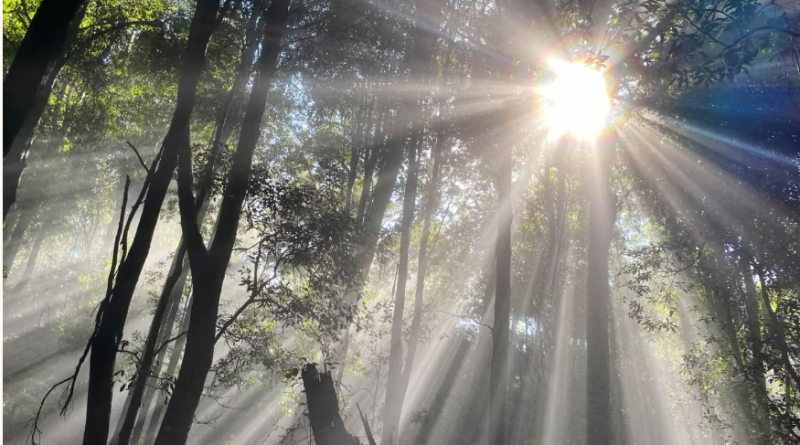
Cover photo: ‘Outdoor research is not a slippery slope to deployment. It’s how we make sure that any future decision is based on facts, not fear or wishful thinking.’ Photograph: Lisa Martin/AAP