

Financing Africa’s manufacturing is not what you thought it to be – a Mining Indaba dialogue

Investors are shifting from pure extraction to bankable industrial projects that integrate minerals and industrial inputs
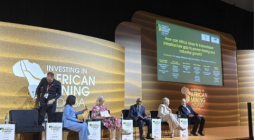
Based on a dialogue themed The role of development and commercial finance in deepening Africa’s manufacturing value chains, here are the financing quandaries we face to move beyond extraction and achieve local manufacturing.
Trade winds have changed, and global investors are seeking bankability. In this new industrial era, the primary constraint on Africa’s progress is not geography or the minerals in the ground; it is the sophistication of financing design.
The pivot from extraction to integrated industrial assets
For decades, the discourse on African industrialisation has been trapped in a cycle of “navel-gazing”—a persistent habit of admiring the problem through dense policy documents without actually moving the needle on production.
Today, the tectonic plates of global trade are shifting. Driven by the voracious demand of the global clean energy transition—specifically for electric vehicles (EVs) and green hydrogen—and accelerated by geopolitical fragmentation, supply chains are being radically reconfigured.
“Investors are seeking bankable industrial projects and not just extraction,” advises Ken Osei, Principal Investment Officer – Manufacturing & Consumer Services at the International Finance Corporation (IFC).
The era of the junior miner who simply digs a hole and exports the contents is nearing its end. As geopolitical tensions drive a trend toward “near-shoring” and “friend-shoring,” Africa is being re-evaluated as a vital link in the manufacturing value chain.
Investors are increasingly shifting from pure extraction to bankable industrial projects that integrate minerals, metals, and industrial inputs into a broader framework.
This means moving beyond the pit-to-port model toward sophisticated assets that can support the manufacturing of EV components and green energy infrastructure.
Development finance is patient capital, not cheap money
A persistent “sense of entitlement” exists among many project promoters who view Development Finance Institutions (DFIs) as sources of subsidised or “cheap” funding. This is a fundamental misunderstanding of the DFI mandate.
As Osei points out, the true value of institutions such as the IFC and the Industrial Development Corporation (IDC) lies in providing “patient capital.”
For high-impact sectors like steel, cement, fast-moving consumer goods (FMCG) and the automotive sector—which accounts for 7% of South Africa’s GDP—commercial banks often lack the appetite for the necessary 10-to-15-year debt tenors.
DFIs provide this longevity, but they demand commercial and financial sustainability in return.
To be bankable, a project must be able to sustain itself in the long run; impact is not an afterthought, but it must be underpinned by a rigorous business case.
The PowerPoint trap vs. the working capital killer
There is a yawning chasm between a project that looks flawless on a PowerPoint slide and one that survives the friction of real-world dynamics.
Lenders are increasingly wary of “slide-ware” that neglects the granular, “boring” variables: tariffs, input price volatility, and, most critically, payment terms.
A project might boast a “great offtake” agreement with a major blue-chip contractor, but the design is flawed if that contractor insists on 180-day payment terms. For a small or medium-sized manufacturer, 180 days is a death sentence.
As David Renwick, Global Head: Investment Banking Division, Absa Corporate & Investment Bank, notes, without a financing design that addresses these working capital gaps, even the most visionary industrial project will run out of cash before the first invoice is settled.
The hidden killer: Currency and revenue mismatch
One of the most frequent causes of project collapse across the continent is the fundamental failure to match the currency of debt with the currency of revenue.
It is a simple principle that is ignored with startling frequency. If you borrow in hard currency but earn in local currency, you aren’t investing, you’re gambling.
Industrialists are often attracted by lower Dollar or Euro interest rates than domestic rates. However, the volatility of local currencies such as the Rand and the Zambian Kwacha can cause a debt burden to explode overnight.
“The simple principle is trying to match your revenues and your expenses in the same currency… we’ve seen too many projects across the continent being funded in hard currency while the selling price is in local currency,” states Renwick.
The catalytic signal of de-risking as a multiplier
DFIs such as the IDC and IFC play a catalytic role, but their balance sheets are finite. David Jarvis, Acting COO at the IDC, notes that his institution hasn’t been recapitalised for decades, making financial sustainability as crucial as their developmental mandate. Their primary power lies in “crowding in” the private sector by acting as a de-risking mechanism.
When a DFI takes a subordinated or long-term position in a project, it signals to commercial banks that the venture is an “investable asset class.” The IDC clearly saw this in the Renewable Energy Independent Power Producer Procurement Programme (REIPPPP), where it and the DBSA played instrumental roles in de-risking the REIPPPP, demonstrating to mainstream capital that African industrial infrastructure is a viable destination for scale and replication.
Cover photo: [annlisa]©123rf.com