

Trump revokes landmark ruling that greenhouse gases endanger public health
Trump administration officials are stressing that overturning the regulation will save more than $1tn and will help cut the price of energy and transport.
Reversing the finding will reduce automobile manufacturers' costs by $2,400 per vehicle, the White House claimed.
These regulations have been an economic strain, said Diana Furchtgott-Roth, who served in the US Department of Transportation during the first Trump term.
"The burden on the economy results in higher prices and manufacturing has left. It's gone to China, where it's made in a dirtier way," she told the BBC.
"So to say that we're reducing global emissions by ending energy intensive manufacturing in some countries, then having it go to China and India, where it's made in a dirtier way, does not reduce global emissions."
Many environmentalists are sceptical of the potential cost savings being touted by the Trump team.
"It's going to force Americans to spend more money, around $1.4tn in additional fuel costs to power these less efficient and higher polluting vehicles," said Peter Zalzal from the Environmental Defense Fund.
"We've also analysed the health impacts and found that the action would result in up to 58,000 additional premature deaths, 37 million more asthma attacks," he said.
For some in the US car industry there will be uncertainty about the rollback as manufacturing less fuel-efficient vehicles might limit their sales overseas.
"This rollback is sort of cementing things that have already been done, such as the relaxation of the fuel economy standards," said Michael Gerrard, a climate law expert from Columbia University.
"But it really does put the US automakers in a bind, because nobody else is going to want to buy American cars."
While the reversal will help the White House to roll back climate change regulations, there are likely to be unintended consequences, according to some observers.
While working on overturning the finding, the Trump administration also utilised the 2009 ruling to prevent states from passing laws that would be stricter on carbon emissions.
The fact that the finding gave responsibility for regulating warming gases to a federal authority was also used to suppress what are termed "nuisance" lawsuits, brought by individuals or organisations on the climate question.
"The endangerment finding decision has blocked any number of lawsuits, and has been pretty powerful in keeping plaintiffs' claims out of court ," said Meghan Greenfield, now with Washington law firm of Jenner & Block.
"I would expect states and non-profit groups to bring suits, probably primarily in our state courts, to try to figure out where the contours of this new law are."
Challenging climate science
One key argument about the reversal of the endangerment finding will be about the science on which it is based.
The Department of Energy formed a panel of scientists to write a report last year challenging widely accepted science on the warming impact of greenhouse gases.
That report underpinned the initial proposal to reverse the 2009 finding.
But many climate experts complained that the panel behind the report was unrepresentative and filled with people who were sceptical of the human influence on warming, and that it was inaccurate and misleading.
While it's not clear how much the Trump administration will rely on this report to face off any challenges, a federal judge recently ruled that the department had violated the law in the formation of the hand-picked team that wrote it.
In fact, a challenge in court on the reversal of the endangerment finding may well be what the Trump administration is now looking for.
Many legal experts believe that they want the proposal to be tested in the Supreme Court before Trump's term ends, believing that if they win, the endangerment finding will be consigned to history.
"This is really different as the EPA is exiting the space entirely and wants to do it on a permanent basis," Meghan Greenfield said.
"If they were to win that issue as they framed it before the Supreme Court, a new presidential administration could not change that position, in the absence of new legislation."
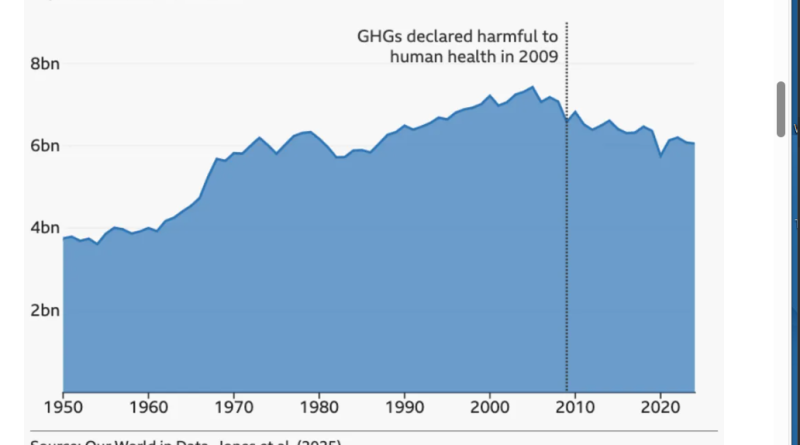
Cover photo: Our World in Data, Jones et al. (2025)