

Cocoa Colonies & Chocolate Empires
Decolonizing Bittersweet Chocolate Value Chains
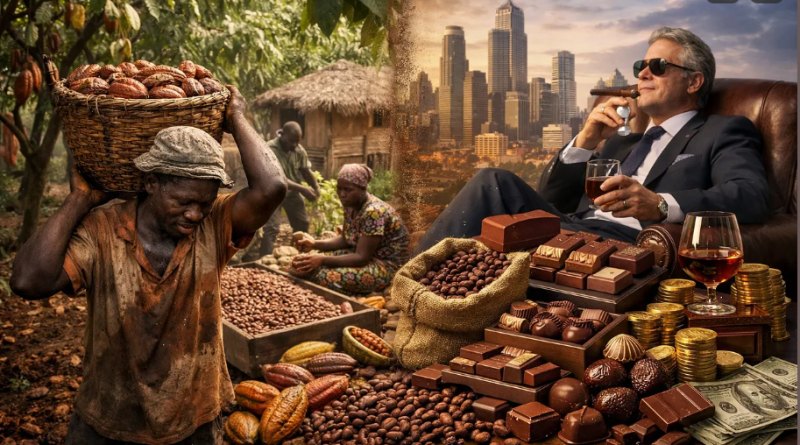
The world’s chocolate economy is built on an uncomfortable neocolonial paradox: Africa produces most of the cocoa beans, but the Global North captures most of the value through processing, branding, marketing, and retail gatekeeping. This is a classic case of neocolonial extraction from the Global South. Let’s start with the core fact that rarely makes it into “ethical chocolate” campaigns: cocoa is overwhelmingly an African commodity. Cacao is a non-native colonial crop that was introduced to Africa by European empires in the 19th century.
According to the International Cocoa Organization (ICCO), Africa produces roughly 71–74% of global cocoa bean production in recent cocoa years. Cacao is 100% a Global South commodity with the largest producers being Côte d’Ivoire, Ghana, Ecuador, Nigeria, Cameroun, Brazil, and Indonesia. Yet most of the value is captured by Global North corporations. Cocoa, like so most Global South commodities such a coffee, tobacco, cotton, and strategic minerals (read my post about the olive oil industry), is trapped in a familiar neocolonial arrangement: the Global South exports a raw or minimally processed input, while the Global North controls the profitable segments via industrial processing (“grinding”), manufacturing, global brands, and supermarket shelf space.
The higher value-added creation in the cocoa business begin outside the farm gate. Cocoa beans are processed into liquor, butter, and powder (“grinding”), and then transformed into branded consumer products. In practice, the strategic command nodes are dominated by a concentrated set of multinational processors and brand owners. Even where “origin grinding” exists, it is often controlled by Global North firms operating in Africa, not by African-owned industrial heavyweights. A Reuters report on Côte d’Ivoire’s grind data notes that the country’s grinding output includes production from major grinders such as Barry Callebaut, Olam, and Cargill, and describes Côte d’Ivoire as the world’s largest cocoa producer while also noting competition for global grinding leadership with the Netherlands. In other words, even when processing happens “in Africa,” the corporate ownership of processing capacity and the profit repatriation channels often remain fully captured by the Global North.
In the last few years, cacao prices have reached $10,000 per ton, but in Côte d’Ivoire and Ghana, cacao prices at the farm gate only fetched a fraction of the New York futures price (See graph below). The Financial Times reported on the cacao smuggling out of Côte d’Ivoire over the last few years. When global market conditions squeeze producers at the bottom of the value chain, they create perverse incentives for illegal trade, corruption, and illicit financial flows to further abuse countries like Côte d’Ivoire of what is rightfully their national wealth. Even the EU’s so-called Deforestation Regulation (EUDR) is not going to be able to address the cacao bean smuggling and will de facto exempt the traceability requirements since it’s not a deforestation concern. In other words, this is a new mode of colonial abuse rubber stamped by EU trade regulators.
The extraction of value in the cacao-chocolate industry is not a mystery; it is measurable variable. According to an Oxfam report (April 2025), for a standard milk chocolate bar sold in Germany, supermarkets capture about 42% of the value, while cocoa farmers receive less than 9%. That one statistic explains the political economy of cocoa imperialism better than a thousand corporate sustainability brochures. It is retail and branding power that decides who earns what, not the geography of cacao production or the hard work of the farmers.
Now, let’s take a look at the concentration of profitability in the chocolate industry:
-
Hershey (United States) reports an operating profit margin of 25.9% in 2024.
-
Mondelez (United States) reports FY 2024 operating income margin of 17.4%.
These are not “normal” margins for a sector allegedly struggling to pay farmers decent wages, and invest in better living conditions for farming communities. These margins are consistent with what I call abusive market power. That is the power to set prices, terms, pass through costs, and the power to defend shelf space in high income retails markets.
Who are the chocolate heavyweights?
To better understand the cacao empire, it is helpful to separate the cocoa economy into three corporate layers:
1) Cocoa processors or grinders: This is the industrial conversion of cacao into butter, powder, and liquor. These firms sit between producers and consumer brands, and they control a major value choke point in the global value chain:
-
Barry Callebaut (Switzerland), which is often described as the leading cocoa/chocolate manufacturer/processor in the world.
-
Cargill (United States), which is a major cocoa and chocolate processor with global supply chain integration. Cargill is also a member of the so-called ABCD corporations that control the majority of the global food system (Cargill is the “C” in ABCD).
-
Olam (Singapore), which has the third largest cacao processing footprint globally, and is a major player in Côte d’Ivoire’s cacao grinding sector.
2) Global brand owners: These are the Global North consumer-facing chocolate and confectionery heavyweights of the industry. This is where marketing rents and brand premiums are captured:
Cover photo: By Global South Perspectives
-
Hershey (United States), which had an operating profit margin of 25.9% in 2024.
-
Mondelez (United States), which had an operating income margin of 17.4% in 2024.
-
Other major brand owners include Nestlé, Mars, Ferrero, and Lindt to mention a few, but here is the list of the confectionery heavyweights. Yes, I noticed that too: zero companies from the Global South.
-
3) Retail and supermarkets: These are the gatekeepers of shelf space in the Global North. Supermarkets are not passive “channels.” They often capture the largest slice and control the terms of entry, especially through private label. Even if the Global South manages to break through the first two layers of market entry of processing and branding, if you don’t have shelf space, you’re cut off from consumers in high-income markets like the US and EU. That being said, some efforts have been made to challenge the supremacy of the chocolate heavyweights, but they remain at the margin of the industry in niche markets.
The structural diagnosis
Cocoa’s injustice is not mainly about “bad actors.” It’s about a system that assigns price and climate risk to smallholders in West Africa and the rest of the Global South, and pricing power to processors, brands, and retailers in the Global North. That is why public debate keeps circling around “ethical sourcing” while the fundamentals do not change. If farmers receive less than a 10% share of final value while supermarkets take more than 40% and branded firms post 17–26% operating profit margins, the core issue is structural bargaining power, not a shortage of corporate commitments or the risk of bankruptcy for multinational corporations.
Can the Global South decolonize chocolate?
The Global South must stop acting as a set of fragmented exporters and start acting as a bloc that reorganizes the terms of trade, investment, and value capture. I explained in my last post how Tunisia and the rest of Global South can decolonize the global olive oil industry. Similarly, Côte d’Ivoire, Ghana and the rest of the Global South, as the exclusive producers of cacao beans, can coordinate joint industrial policies to reclaim their rightful place in the global chocolate market.
A serious strategy cannot be centered around producing more cacao, but rather about capturing more value and asserting our collective weights across the entire value chain. That implies a coherent and comprehensive Global South strategy with four basic pillars:
-
Regional industrial policy to scale Global South and African-owned grinding/manufacturing capacity, rather than merely host foreign-owned plants.
-
Collective bargaining by major producers (especially Côte d’Ivoire and Ghana) not only on farm gate price mechanisms, but on processing terms, brand licensing, and long-term offtake contracts.
-
In short, cocoa is not just an agricultural commodity. It is a map of how global markets are structured to preserve the Global North’s neocolonial command over value chains. The world does not merely “consume chocolate.” It consumes a neocolonial institutional architecture that systematically leaves African producers carrying the risk while others collect the rents.
-
South–South market building and retail alliances to reduce dependence on Global North supermarket gatekeepers who currently capture more than 40% in major consumer markets.
-
Development finance targeted at logistics, quality control, branding, and standards infrastructure because the premium is earned in those nodes, not at the export docks.