

“We’ve taken the position that we won’t be spending money on the pipeline,” she said. “We’re not the proponent. Alberta’s looking for a pipeline proponent.”
But last January, former Alberta energy minister Sonya Savage warned there was no way a fast-tracked western pipeline would attract private investment without a taxpayer “backstop”. This week, Simon Fraser University political science professor Andy Hira said there’s no reason for governments to buy in.
While a twinned southern pipeline would make more sense than the northern route, “the question I would raise is why would we put public funding into this,” he told The Energy Mix in an email. The existing Trans Mountain expansion “is likely to lose public money, reinforcing why the private sector did not want to invest in the first place.” A new project would face opposition from First Nations and environmental groups, logistical and physical construction issues, and the even bigger risk of inflation and economic uncertainty, Hira added.
While the governments of Canada, Alberta, and B.C. stake out their choices between pipeline routes, independent analysts who followed the tortured history of the Trans Mountain pipeline expansion are warning that a southern route will face many of the same hurdles.
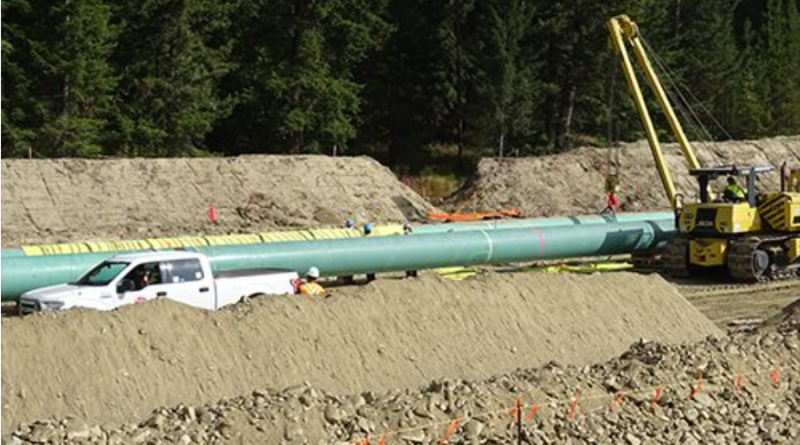
Last fall, with fossil companies and some public officials calling for renewed government support for a new pipeline, the Institute for Energy Economics and Financial Analysis (IEEFA) called Trans Mountain (TMX)’s $35.6-billion price tag (up to that point) a “red flag” for any future projects.
“The chances for recouping public funds that have been sunken into the TMX are slim,” wrote IEEFA analysts Mark Kalegha and Suzanne Mattei. The pipeline’s high cost “has put enormous pressure on the pipeline toll-setting process, resulting in vociferous objections from the pipeline’s shippers. Meanwhile, the oil market is increasingly beset by uncertainties that pose risks to TMX’s long-term profit margin,” including serious questions about long-term demand for oil exports to China.
“Market conditions do not favour a long-term reliance on Asia for oil exports,’ IEEFA warned. “Major new oil pipeline construction could lead to government-funded bailouts, as has been seen with the TMX—resulting in substantial outlays of public money that may never be recovered.”
‘Immense’ Risk of Stranded Assets
Analysts echoed and expanded on those concerns in reaction to this week’s news reports.
“There is immense stranded asset risk in any new major fossil fuel expansion, particularly those from Canada’s oil sands,” Michael Sambasivam, senior analyst at Investors for Paris Compliance, told The Mix in an email. “While industry is using high prices as a selling point for new oil infrastructure, we’re witnessing demand destruction driven by this price shock. This is exacerbated by the degree to which the cost of renewable power generation has plummeted over the last few years.”
Sambasivam said proponents of a southern route may be prepared to trade off “the ire of oil sands producers who would rather see more exports out of a northern B.C. port” against the possibility of a lighter regulatory burden for a fully or partially twinned southern pipeline.
But that plan “would likely require all the same consultations as any other standalone pipeline,” he wrote. “Consultations with affected First Nations are constitutionally required and not offset by the use of an existing route. The impacts of increased tanker traffic will very clearly dictate new consultations with coastal Nations, as well.”
Meanwhile, “while Bill C-5 aims to reduce the regulatory burden regarding environmental impact assessments, any bypassing of impact assessment will likely have an inverse effect on the success of consultations with First Nations.” And since there’s no past model for the fast-tracked approval process the federal government has been promising, “there will likely be new legal challenges as precedents get set. Forcing this through without transparent and thorough due diligence could create more delays than it solves.”
University of British Columbia political science professor Kathryn Harrison said a new southern route could point to a terminus in either Burnaby or Delta, B.C. Burnaby is the site of the expanded storage tank farm that has already raised serious red flags for local residents. Either option would increase the risk to the endangered southern resident killer whale population that was one of the focal points for opposition to the previous TMX expansion.
But beyond environmental risks lurk “even bigger political challenges,” Harrison wrote in an email. “Would a southern route be the same as the TMX route? If not, it’s likely to provoke opposition from communities that have never had a pipeline before. In Burnaby, there’s known resident opposition. They lost last time round, but it’s not clear to me that the implication is that they’d welcome more than doubling the capacity of the two current pipelines. A pipeline to Delta would cross new neighbourhoods, who I expect wouldn’t be happy.”
She added that four southern First Nations remain opposed to TMX, there’s no sign they would support a pipeline expansion, and a route to Delta would engage a different set of Nations.
No New Pipeline Before 2035
While the fossil industry is touting new pipeline capacity as a response to the immediate energy price shock brought on by Donald Trump’s war on Iran, Sambasivam said no developer would be able to bring a new pipeline online before 2035—at the earliest. Even with the federal government pledging to compress regulation and speed up permitting for a new project, the 12-year time span for the Trans Mountain expansion included a five- to six-year period of active construction, and new infrastructure would face formidable obstacles: no corporate sponsor has stepped up to finance it, Calgary-based pipeliner Enbridge Inc. has declared it isn’t interested in the development risk, and “the impact of nations aiming to shore up domestic energy security will likely be a factor which deters financiers from joining the project,” a gap that would either delay a final investment decision and push the timeline even later.
As that timeline takes shape, investors will see it as less and less likely that a new pipeline would ever recover its costs. While demand projections vary, “there is a high likelihood of global oil demand plateauing over the next decade, which could be exacerbated by uptake in renewable power generation and EV usage,” Sambasivam wrote. “Looking out to 2055-2060, around when such a pipeline would approach the point of being fully paid off, there is a high likelihood that reductions in global demand will have made high-cost oil sands completely economically inviable.”
That, in turn, could explain why Canadian oil sands producers “have largely been focused on the expansion of existing mines rather than new standalone production,” he added. “New greenfield projects are about 60% more expensive than brownfield, which would place new Canadian projects at a competitive disadvantage.”
So investors will be weighing whether a new pipeline will ever break even in an uncertain global market being transformed by less expensive renewable energy. “A costly project like this would have a pretty long payback time, so we’re looking 10 to 20 years out at a time of tremendous global instability,” Harrison wrote. “The big question on my mind is how consumers and governments in importing countries respond to two concurrent developments: the increasing instability of oil prices (this latest spike is the second in just four years), and the potential to substitute homegrown renewable electricity, with stable prices, at a time when renewables are now cheaper to install than fossil fuel power plants in most places in the world and EVs from China are increasingly affordable.”
“What we do know ,” she added in an Earth Day email, “is that meeting the goals of the Paris Agreement demands a dramatic reduction of fossil fuel consumption globally, on the order of 80% for oil. So any future scenario in which Canadian oil exports are thriving in 20 years is not a secure scenario for Canadians or humankind.”