

Germany’s Hydrogen Backbone & the Long Shadow of Russian Gas
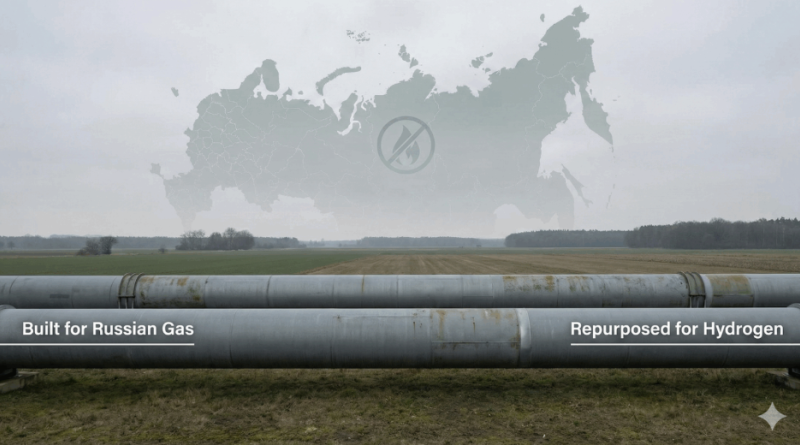
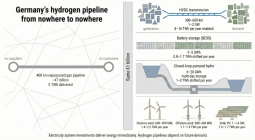
Germany’s newly pressurized hydrogen backbone segment with no suppliers and no customers is often described as a clean break from the past, a necessary early investment in a future hydrogen economy. The steel tells a different story. The route, diameter, age, and economics of the pipeline point back to Russian natural gas, not forward to hydrogen demand. This segment looks less like a greenfield climate asset and more like the continuation of a gas strategy whose original assumptions collapsed, with hydrogen providing a new narrative and a longer amortization horizon.
The physical facts matter. The hydrogen segment in question runs roughly 400 km between Lubmin on the Baltic coast and Bobbau in Saxony-Anhalt. It is a DN1400 pipeline, 1.4 m in diameter, capable in natural gas service of carrying on the order of 55 bcm per year. On an energy basis, that corresponds to roughly 540 TWh per year, or an average power flow of about 62 GW. Pipelines of this size are not generic. In Germany, there is only one recent system that matches this profile and geography: the EUGAL pipeline corridor commissioned in 2020 to carry Nord Stream gas south through Germany. Based on public information about diameter, route, commissioning dates, and operators, my assessment is that the hydrogen conversion is drawing on EUGAL steel. This assessment is based entirely on publicly available sources and inference, not on inside knowledge.
EUGAL was not an incremental upgrade to an aging network. It was one of the newest and most capital intensive gas transmission investments in Europe. The full EUGAL project cost around €2.6 billion for roughly 480 km. Scaling that to a 400 km segment implies original capital expenditure of about €2.2 billion. The pipeline was commissioned in 2020, meaning that by 2025 it is only about five years old. Under German gas network regulation, high pressure steel pipelines are depreciated over long lives, commonly between 45 and 65 years. Even using the shorter end of that range, more than 85% of the original regulated book value remains. Using the longer end, more than 90% remains. In simple terms, roughly €2.0 billion of methane era capital is still being recovered through regulated tariffs when the pipeline is repurposed.
The political context in which this steel was laid cannot be separated from the economics. Germany made a deliberate choice over several decades to anchor industrial competitiveness on large volumes of pipeline gas from Russia. The logic was price stability, supply security, and the belief that economic interdependence would moderate political risk. This logic survived repeated shocks, including gas disputes with Ukraine, the annexation of Crimea in 2014, and the downing of MH17. By the time EUGAL was approved and built, the risks were visible and widely discussed, particularly by Poland and the Baltic states. Germany chose to proceed anyway, doubling down on north to south gas transmission capacity tied to Nord Stream volumes.
Former German Chancellor Gerhard Schröder’s role in this period is often treated as an embarrassment best forgotten, but it is more useful to see it as a signal of how normalized Russian energy alignment had become in German political and corporate circles. Schröder championed Nord Stream as chancellor, then moved directly into senior roles within Nord Stream and Rosneft after leaving office, continuing to publicly defend Russian energy interests well after Crimea. This was not an isolated anomaly. It reflected a broader comfort with Russian state energy companies as partners, even as geopolitical risks accumulated. By the late 2010s, this comfort was embedded in institutions, not just individuals.
Corporate structures reinforced this alignment. GASCADE, the operator of EUGAL, was for many years majority owned by Gazprom Germania alongside Wintershall Dea. Gazprom Germania was Russian natural gas firm Gazprom’s German holding company, controlling pipelines, storage, and trading operations. After Russia’s invasion of Ukraine in 2022, Gazprom Germania was seized by the German state and renamed SEFE. Ownership changed, but the pipelines did not. Their regulatory treatment did not reset. Their depreciation schedules did not restart. The steel remained in the regulated asset base, earning allowed returns and depreciation recovery regardless of who held the shares.
Understanding how regulated gas pipelines make money is essential to understanding why repurposing occurred. German transmission system operators earn revenue based on a regulated asset base, allowed depreciation, and an allowed return on equity, all subject to a revenue cap. Pipelines are not merchant assets whose revenues rise and fall directly with throughput. Utilization risk is smoothed through regulatory accounts. If volumes fall, tariffs per unit rise. As long as the asset remains recognized, its capital is recovered over time. A pipeline does not need to be full to be paid. It needs to remain classified as necessary infrastructure.
Under the original gas case, EUGAL’s economics were straightforward. A €2.2 billion asset depreciated over 45 to 65 years implies annual depreciation recovery of roughly €35 million to €50 million. On top of that, the allowed equity return applies to the equity portion of the regulated asset base. Assuming a 40% equity share and allowed pre tax returns in the range set by German regulators, the equity return component would plausibly be on the order of €30 million to €50 million per year. Before counting operating costs, the pipeline could expect capital related allowed revenues of roughly €70 million to €100 million per year for decades, so long as it remained in service. This recovery was largely independent of whether gas actually flowed at design capacity.
That business case collapsed in early 2022. Russia invaded Ukraine in February. In September, Nord Stream 1 and 2 were sabotaged. The supply rationale for EUGAL disappeared almost overnight. A pipeline designed to move 55 bcm per year of Russian gas south through Germany no longer had a source. In a market setting, this would trigger write downs and loss recognition. In a regulated setting, it triggers a search for continued relevance.
The hydrogen pivot provided that relevance. By reclassifying part of the pipeline as hydrogen infrastructure, the asset remains inside the regulated perimeter. Conversion costs are added to the asset base rather than written off. The economic life is extended. Public statements emphasize future hydrogen demand and climate alignment. The key point is that none of this requires hydrogen to flow today, or even soon. It requires regulatory approval and a narrative of future necessity.
The timing of Germany’s hydrogen diplomacy adds an uncomfortable layer. In early 2022, Germany established a hydrogen cooperation office in Moscow as part of its international hydrogen diplomacy framework. This was not an embassy, but it was an official government presence focused on hydrogen cooperation. It was set up months before the invasion, after Crimea, after repeated energy coercion, and at a time when EUGAL was already in operation. The message was continuity. Even as fossil gas ties became politically fragile, Germany was planning post fossil energy cooperation with Russia rather than decoupling.
Technically, the converted pipeline is presented as having a hydrogen capacity of roughly 20 GW, down from its original natural gas capability of about 62 GW. This derating reflects hydrogen’s properties, pressure limits, and operational constraints. Utilization assumptions are critical. If the hydrogen pipeline operates at 10% utilization, which is optimistic given the reality of green hydrogen supply and demand, it delivers about 17.5 TWh per year. The original gas pipeline, even at 70% utilization, would have delivered around 380 TWh per year. The delivered energy collapses by a factor of more than 20.
Germany’s hydrogen strategy-era projections assumed total domestic demand of roughly 110–130 TWh across refining, petrochemicals, ammonia, steel, transport, power generation, and e-fuels, but a realistic end-state assessment collapses that figure to perhaps 4–14 TWh. Oil refining demand of 25–30 TWh disappears entirely as fuel refining declines. Transport, e-fuels, and buildings and heat, together projected at 25–40 TWh, are eliminated as direct electrification dominates. Domestic steel, once assumed to require close to 30 TWh, falls to zero as scrap availability, electric arc furnaces, and imported clean iron units displace hydrogen-based direct reduction, with any residual reduction more likely to rely on biomethane before hydrogen. Power generation shrinks from a projected 10–20 TWh to at most 0–1 TWh as a form of limited capacity insurance rather than a material energy source.
What remains is largely petrochemicals, perhaps 4–8 TWh for hydrogenation and purification where hydrogen is chemically unavoidable, and a small residual of domestic ammonia production in niche cases, possibly up to 5 TWh, with imports covering most needs. The result is an order-of-magnitude gap between the hydrogen volumes Germany planned its backbone around and the volumes its industrial system is likely to require, underscoring how infrastructure sizing drifted far beyond realistic demand.
Costs do not collapse with radically diminished capacity. Taking the remaining methane era book value of roughly €2.0 billion and adding an estimated €1.0 billion in hydrogen conversion costs yields a total regulated capital base near €3.0 billion. Depreciated over 40 to 60 years, annual depreciation recovery alone is about €50 million to €75 million. Allowed equity returns add roughly €40 million to €60 million per year. Capital related allowed revenues therefore fall in the range of €90 million to €135 million per year. At 17.5 TWh of delivered hydrogen energy, that translates to €5 to €8 per MWh of hydrogen just for capital recovery and equity remuneration.
That figure is only one component. Earlier calculations showed that low utilization multiplies network costs per unit of energy by roughly twentyfold compared to the original gas case, pushing pipeline related costs toward €60 to €70 per MWh of hydrogen on an energy basis. When hydrogen is converted back to electricity at 50% to 60% efficiency, the pipeline alone contributes roughly €0.10 to €0.15 per kWh of electricity, before electrolysis, storage, compression, or generation costs are included. The €1.0 billion conversion adds a few more euros per MWh. It does not change the conclusion. The dominant driver is stranded capacity spread over minimal throughput.
Germany has already acknowledged that hydrogen network charges would be prohibitively high if early users were asked to cover full costs, and has moved to subsidize them. The federal government has put in place a state aid scheme of roughly €3 billion, approved at the EU level, to support the hydrogen core network during its ramp-up phase. This support takes the form of state guarantees and preferential financing for hydrogen transmission operators, allowing them to borrow at lower cost and run the network with tariffs set below cost recovery in the early years. The gap between allowed revenues and collected network charges is booked into an intertemporal amortisation account and scheduled to be recovered over a long horizon, explicitly extending to around 2055. In practice, this means that early hydrogen users are shielded from the true cost of an underutilized network, while the state absorbs financing risk and commits future network users and taxpayers to decades of deferred cost recovery.
The distribution of impacts is uneven. Ratepayers and future hydrogen users bear higher unit costs. Electricity consumers see those costs when hydrogen is framed as a firming or balancing resource. The transmission operator continues to recover capital and earn allowed returns. The political system avoids acknowledging that a €2.6 billion gas investment built in 2020 was premised on a geopolitical assumption that failed within two years.
Germany should start from a clear diagnosis that this pipeline segment is already a stranded asset in practical terms, even if it has been administratively reclassified. Hydrogen supply is uncertain, demand is thin, and the economics rely on subsidies and deferred recovery rather than use. Long before 2030, it will be evident that the expected volumes are not materializing at anything close to the level needed to justify continued operation, further conversion spending, or decades of amortisation. At that point, the relevant question will not be how to stimulate hydrogen demand to save the asset, but how to limit the total cost of acknowledging that the original gas investment failed and that the hydrogen pivot did not change that reality.
The lowest-cost response for taxpayers when that recognition occurs is a decisive exit rather than continued smoothing. Germany should remove the segment from the hydrogen core network designation, halt further hydrogen-specific capital spending, and formally de-recognize the asset from the regulated base. That step alone prevents additional costs from being layered onto an asset that is not delivering commensurate public value. The remaining book value should then be addressed through accelerated depreciation and an explicit impairment settlement, in which owners absorb a substantial share of the loss and the state caps its exposure through a one-time resolution rather than decades of tariff-backed recovery. This approach concentrates the financial pain into a short, transparent period, but it minimizes total taxpayer cost by avoiding prolonged subsidies, financing guarantees, and repeated retrofit efforts. Trying to keep the pipeline alive through discounted network charges and long-dated amortisation may feel gentler, but in present-value terms it is the most expensive option Germany could choose.
None of the story of this dead on arrival pipeline from nowhere to nowhere requires assuming bad faith or hidden coordination. The outcome follows from path dependence, regulatory incentives, and a reluctance to recognize losses on relatively new infrastructure. Building a high capacity pipeline for Russian gas in 2020 was already a bad economic and climate idea. Hydrogen did not create the problem, and it cannot resolve it. It is currently being used to postpone acknowledging that the underlying asset is already stranded, and that the least costly response will be to accept that reality and close the chapter rather than extend it.
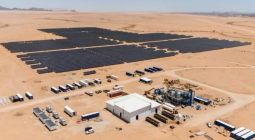
Cover photo: Google Gemini generated this conceptual illustration highlighting the physical continuity between infrastructure originally built for Russian natural gas and the proposed German Hydrogen Backbone.