

What Solar Panels Make Possible
“Missing the forest for the trees” is an idiom meaning you’re so focused on small details that you fail to grasp the larger context. It’s a saying that I think of when I see people focusing only on solar panels without seeing what they make possible. The collateral benefits, so to speak.
Like an Arkansas school board using solar panels to keep teachers by paying them bigger salaries; the many schools using their solar installations as part of student learning; the farmers using solar panels to shelter their crops while generating power (agrivoltaics); and the communities in the United States and India reaping many benefits from using the panels to shelter irrigation canals.
These are win-win-win stories which look at solar power in the context of the lives of people and communities, not at solar panels as a stand alone issue. And that matters, in terms of how we move towards increased generation of power from renewable sources.
I first realized this when I was reading about the late Ray C. Anderson, who ran a carpet-making business in Atlanta, Georgia, and became a powerful advocate for making business sustainable. His mission has been continued magnificently by the Ray C. Anderson Foundation, in Georgia and elsewhere, even as it is contemplating sunsetting by 2030.
It was in reading more about Ray’s journey to sustainability that I came across an anecdote that has remained with me.
It was about a man who had farmed corn for decades but was thinking about retiring. To fund his retirement, because like so many farmers he had no pension and his farm was his only asset, he was contemplating installing solar panels on his farmland. To critics, his response was straightforward. He had been using the sun to grow corn for decades; now he would use the sun to grow the money for his post-farming life.
For him, the solar panels were a continuation of how he had farmed. And given how much debate there was at the time about the use of farmland for solar power generation, his point of view changed how I perceived the issue.
The same shift in perception may have happened in Batesville, Arkansas, a town of about 10,000 just 17 miles west of the state’s largest coal-fired power plant, which is set to shut down by 2030. The high school’s yearly utility bills often topped $600,000 which made it very difficult to retain teachers at a time when school enrolment was declining in the area.
When Michael Hester became superintendent of the Batesville School District in 2017, the district was underfunded by $250,000. It paid the lowest teacher salaries out of the five districts in Independence County, Arkansas, and was losing great teachers because of the low pay. Finding a way to keep their best educators was job one, so to speak.
What he and the board did has become a model for at least 30 other schools, a hospital, and a junior college in the region. It began with carrying out an energy audit which showed that the school district could save at least $2.4 million over 20 years if it outfitted the Batesville school with more than 1,400 solar panels and updated the district’s facilities with new lights, heating and cooling systems, and windows.
Adopting that strategy in 2017 has helped the district slash its annual energy consumption by 1.6 million kilowatts (solar generates half its power) and in three years, transform that $250,000 budget deficit into a $1.8 million surplus. By 2022, the solar panels collected more energy than the schools needed, which the district sold to the power company.
Those savings made it possible for the board to increase teacher salaries, which now rank highest in the state. An unexpected additional benefit has been the real-world lessons in renewable energy generated by and for students, as well as the impact the strategy has had on at least 30 other schools.
The schools in Batesville aren’t alone. At least 7,300 schools across the U.S. are using solar to save on utilities, introduce students to renewable energy and—in some cases—reduce their emissions, says Generation 180, a nonprofit that advocates for clean energy and tracks the proliferation of solar through the U.S. public education system.
Its report says that in 2019, 16% of U.S. school districts had installed a total of 1,337 megawatts of solar capacity, meaning that about 5.3 million students now attend schools with solar, representing an 81% increase since 2014. If every U.S. public school used 100% solar power, the education system could drive emissions reductions that would be equivalent to closing 18 coal-fired power plants.
Nearly 80% of solar capacity installed at U.S. public schools resulted from power purchase agreements. “That means more than three-quarters of that solar on schools is not coming out of school budgets—it’s getting paid for by a developer who owns, installs and maintains the solar energy system,” said Tish Tablan, a Generation 180 program director. “So they’re seeing no upfront costs and immediate cost savings.”
Because schools are influential community hubs, they are in a position to “equip and inspire people to take action on clean energy in their own communities,” says Tablan.
Farming and clean energy can grow together, as Byron Kominek has been demonstrating since 2016 in Boulder County, Colorado, on the farm which his grandfather Jack started in 1972.
Byron had worked with USAID in Zambia and Mozambique before coming back to the US. “I wanted to see what it would be like to do something in my own culture,” he says. He came up with the idea of installing solar panels to create a micro-climate for his crops underneath them while generating power for people in Boulder.
“Dual use for landowners provides multiple streams of income and oftentimes for farmers and ranchers, it keeps the purpose of the land there,” Byron says. “For our land, it’s really nice having people on the land. I have a couple of thousand people that come out to visit my land every year. It makes me feel part of the community, like I can be a better contributor to the community I live in.”
In Canada, a trade group made up of farmers and solar companies called Agrivoltaics Canada is promoting the concept here. At Canada’s first Agrivoltaics conference in December 2022, experts in renewable energy, farming, and food systems discussed the potential for agrivoltaics to feed Canada’s growing population while reducing its carbon footprint. This was the first conference on this topic ever held in North America.
Research suggests that converting just 4% of Canada’s farmland to agrivoltaics could supply Canada’s electricity needs while creating a sustainable long-term food system that could help feed the 5.8 million food-insecure Canadians, while allowing Canada to export more food even as extreme weather events are taking farmland out of production.
It’s not just agricultural land, either. In Alberta, RenuWell Energy Solutions has been showing that legacy oil and gas infrastructure can be re-purposed to community solar development, providing significant benefits to energy industries, the environment, and the economy.
In 2023, it was awarded a Brownie Award for its solar projects in Taber, Alberta, a collaboration between a municipality, irrigation co-operative and the private and non-profit sectors that will generate enough electricity to power 280 average Alberta households or irrigate 11,700 acres of farmland for a year. Over a 25-year lifespan, they will generate 50,750 megawatt-hours, with greenhouse gas emission savings of 28,420 tCO2e. And in 2024, Renuwell received an Emerald Award from the Alberta Emerald Foundation, which showcases organizations, projects, and individuals across Alberta working to address environmental challenges and build a more resilient and sustainable future.
Using brownfield sites for solar energy projects allows for productive use of the land while long-term bioremediation occurs, says Renuwell president Keith Hirsche. “Instead of removing the roads and power lines during well reclamation, these pieces of infrastructure can stay in place and be repurposed for the solar energy project. This saves time and money for both the conventional and renewable energy industries.”
There are 170,000 inactive wells throughout Albertan in oil and gas fields. Installing solar panels on them would offer a range of benefits to landowners, farmers, consumers, oil and gas companies, irrigation districts and municipalities, and workers in reclamation and solar industries.
Then there are the solar canals. A decade ago, the western Indian state of Gujarat experimented with putting solar panels over top of an irrigation canal. It solved the problem of finding land for solar panels, land in India being expensive and ownership often controversial, and provided electricity for people in rural areas that utilities had found hard to serve.
But it also turned out that those panels did a whole lot more. Less of the water evaporated in the hot climate. The water in the canals cooled the panels so they were more efficient. And there were far fewer weeds to clog up the canals.
Since that first solar canal was completed in 2012, other larger-scale solar canals now wind through India’s countryside, simultaneously solving the two key problems of energy production and water conservation while avoiding controversy over land use.
“These innovative projects can provide cheap and consistent electricity to millions of farmers and improve their profits,” says Manik Jolly, who was involved in the Gujarat pilot project when he worked at SunEdison and is now CEO of Grassroots and Rural Innovative Development, a startup in New Delhi.
Now California is taking the first steps in putting solar panels over top of its 4,000 miles of irrigation canals, aiming to save billions of gallons of water each year and produce enough clean energy to power a city the size of Los Angeles for nine months annually.
California’s canals, which bring water to some 35 million Californians and 5.7 million acres of farmland, are the world’s largest water conveyance system and the state’s single largest user of electricity.
A study estimated that if all the canals were covered with solar panels, it could save more than 65 billion gallons of water from evaporation annually – enough to irrigate 50,000 acres of farmland, or meet the residential water needs of more than two million people.
And it could provide approximately 13 gigawatts of renewable power, equivalent to about one sixth of the state’s current installed capacity or roughly half the projected new capacity needed by 2030 to meet the state’s decarbonization goals. They could protect prime farmland from being used for renewable energy projects as the state works to decarbonize.
Now California is starting to test out those estimates. Project Nexus, a private/public/academic partnership between the California Department of Water Resources, Turlock Irrigation District, and Solar Aquagrid, is online, generating electricity and data. While a global community of water and power officials is watching closely, a groundbreaking initiative led by faculty from seven top research universities aims to accelerate the deployment of solar arrays over California’s extensive canal network.
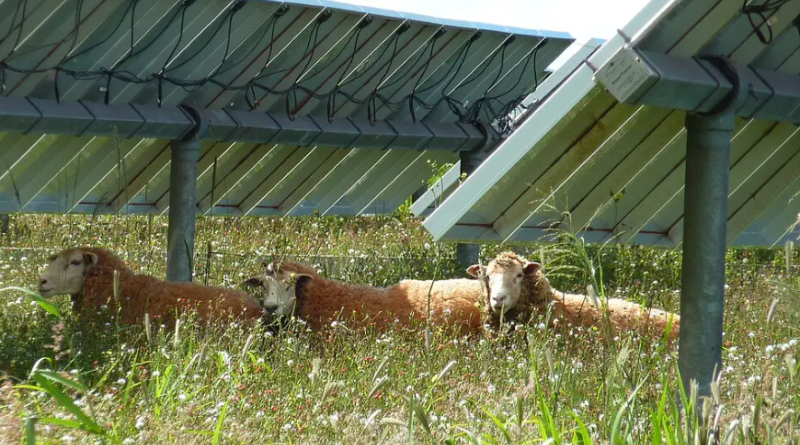
Cover photo: Sheep under solar panels in Lanai, Hawaii. (Merrill Smith/U.S. Department of Energy/Wikipedia)