Trump Judge Hands Another Offshore Wind #FAIL To Trump
Offshore wind turbines have been the bête noire of US President Donald Trump ever since 2013, when he brought a case against an offshore project in Scotland. He lost, and the rage has lingered all these years. The president can’t smack back against wind turbines in Scottish waters, but he can throw hundreds of wind workers off the job here at home, and he has. In the latest maneuver, on December 22, the president ordered work to stop on five major offshore projects under construction. However, once again the president is losing in court….
Two Down, Three To Go
The December 22 stop-work order was issued by the Bureau of Ocean Energy Management (BOEM) in the US Department of the Interior (DOI), which has jurisdiction over the offshore areas leased to wind developers. The order stopped five projects in mid-construction: Sunrise Wind and Empire Wind (both in New York), Vineyard Wind (Massachusetts), Revolution Wind (Rhode Island in partnership with Connecticut), and the Coastal Virginia Offshore Wind project.
Developers in all five cases went to court asking for relief. Earlier this week, a Reagan-appointed federal judge lifted the stop-work order against Revolution Wind. On January 15, Trump’s own appointee, District Judge Carl J. Nichols, did the same for Empire Wind.
It remains to be seen if the stop-work orders are lifted against Sunrise, Vineyard, and the CVOW project. However, all five projects were covered by the same stop-work order. Now that two of them have been reactivated, the Trump administration will have a tougher row to hoe against the remaining three.
What National Security Emergency?
In the December 22 order, the Bureau of Ocean Energy Management cited an unspecified national security issue raised by the Department of Defense. The emergency was supposedly deep, dire, and extreme enough to justify halting five significant energy infrastructure projects totaling 8 gigawatts, some of which were nearly completed. In fact, some of the turbines at the Vineyard Wind project were already producing electricity for the grid.
Alarmed, the governors of four of the impacted states demanded a classified briefing from the Defense Department, since, after all, their citizens’ lives and limbs were purported to be at risk.
No word yet on whether or not the briefing ever materialized, but curiously absent from the fray is the Republican Governor of Virginia, Glenn Youngkin. Somewhat out of character for a Republican office holder, Youngkin publicly supported the CVOW project during his time as governor. Well, most of his time.
Youngkin was term-limited out of office on Election Day 2025, but he remains governor until January 17, when his replacement, Democrat Abigail Spanberger, is sworn in. He was still busy governing when the stop-work order came down on December 22, and he has been busy governing all the days since then, but he has issued nary a peep in defense of the CVOW project, presumably because he is pondering his next step up the Republican Party ladder, where offshore wind turbines are political kryptonite.
Next Steps For The US Offshore Wind Industry
With or without an assist from Governor Youngkin, the CVOW project has a pretty good chance of getting back on track to deliver the clean kilowatts around springtime of this year. At least, that’s what District Judge Carl J. Nichols indicated when he lifted the stop-work order against Empire Wind.
“District Judge Carl J. Nichols, an appointee of President Donald Trump, ruled construction on the Empire Wind project could go forward while he considers the merits of the government’s order to suspend the project,” PBS reported on January 15. “He faulted the government for not responding to key points in Empire Wind’s court filings, including the contention that the administration violated proper procedure.”
“Today, the judge ruled the project would likely suffer ‘imminent irreparable harm’ from the delay and granted the injunction while the merits of the case are being decided,” added the news organization Maritime Executive.
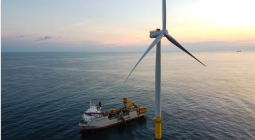
Maritime Executive also provided additional details. “A heavy lift vessel has arrived on-site, and Equinor said it was critical that it, along with the crane, proceeded to place the topside for the project,” they explained. “It highlighted that the vessel is under contract and cannot linger at the sight. It said the company would find it difficult, if not impossible, to store the substation pending a later decision.”
“The company also cited mounting costs from the delays and a threat to its project financing,” Maritime Executive noted.
Whew, That Was A Close One
The developer of Empire Wind is the Norwegian firm Equinor, which also happens to possess considerable oil and gas assets in the US. Equinor dodged a bullet last spring when New York Governor Kathy Hochul personally went to bat for the Empire project after the Trump administration ordered work to halt for the first time.
Equinor was cautiously optimistic about its chances for finishing the project this time around. “Empire Wind will now focus on safely restarting construction activities that were halted during the suspension period,” Equinor stated.
“In addition, the project will continue to engage with the U.S. government to ensure the safe, secure and responsible execution of its operations,” Equinor added, obliquely referring to the multifaceted security reviews undergone by Empire Wind, and the other four projects, prior to construction.
Despite all those security reviews, the December 22 stop-work order came like a bolt out of the blue. So, it will be interesting to see if and when the Defense Department comes to the table with some kind of brand new security issue that has never come up before.
In the meantime, the offshore wind trade organization Oceantic Network had plenty to say.
“Despite the government’s argument that new national security concerns from a recent classified study prompted the action, District of Columbia Judge Nichols granted the injunction because of the lack of notice given to the project before the order was issued and the successful demonstration of irreparable harm to the project,” the organization said in a press statement.
“Additionally, the judge noted the Administration failed to respond to most of Empire Wind’s claims, nor did they contest that the construction pause was an arbitrary and capricious action,” Oceantic Network added.
The organization also took the opportunity to note that the 810-megawatt Empire Wind project is already 60% complete, creating more than 2,000 jobs at the South Brooklyn Marine Terminal in New York, and “kindled the construction of at least eight new vessels from Pennsylvania, Louisiana and Mississippi shipyards.”
“To build this project, the developer purchased export cables from a South Carolina factory and cable components from Upstate New York that prompted the construction of a new factory—microcosms of a supply chain that stretches across 30 states,” they added again for good measure.
Oceantic Network also noted that the December 22 stop-work order impacted 12,000 jobs in all. “Construction of these projects has sparked more than 1,000 supply chain contracts to 675 unique American businesses across 41 states, spanning domestic shipyards, upgraded ports, and a massive resurgence in American steel. More than 24% are coming from Gulf suppliers,” the organization stated.
Gosh, and all this disrupted because of an offshore wind farm in Scotland lo those many years ago….
Cover photo: By Clean technica