

Strategic reframe of the narrative around Africa’s critical mineral resources
The continent’s mineral challenge is one of conversion—turning resources into infrastructure, industrial capacity and regional value chains
The African Finance Corporation’s (AFC) new Compendium of Africa’s Strategic Minerals is all about reframing the continent’s mineral endowment from a catalogue of resources into a system-level economic proposition.
Taking part in a fireside chat at Investing in Mining Indaba, Africa Finance Corporation CEO Samaila Zubairu spoke about the need to “reframe the conversation” around Africa’s critical minerals. “We want policy coordination on how we look at Africa’s mineral resources, to how we create jobs,” said Zubairu.
He used the example of the Lobito Corridor to illustrate how regional corridors can be built around a specific mineral resource, in this case, iron ore.
Policy development and alignment among Angola, the Democratic Republic of the Congo (DRC) and Zambia would facilitate local demand and supply, if mining, logistics, transport, smelting and manufacturing value chains were harmonised.
“It’s about how to align the markets… Why import steel when we have high-grade iron sources on the continent? When you have to import these items over long distances, costs are higher. You want to ensure you can control the supply chain ecosystem. The only way to ensure the supply chain is largely in Africa is for us to do so.
“Because we have most of the sources on the continent, we just have to connect the dots… It’s ensuring efficiency in project implementation.”
Regional infrastructure projects for jobs, economic development
Zubairu said his biggest challenge as AFC CEO is creating jobs for Africa’s burgeoning population, especially given projections that the continent will reach 2.5 billion by 2050. “We need to transform our minerals to feed our people. To build the energy systems required for our future and the world,” he said.
The Compendium notes that, by many estimates, including those of the UN, Africa accounts for around 30% of the world’s known mineral reserves.
“These include the world’s largest current resources of platinum group elements (PGE), industrial diamonds, ferroalloy metals, such as cobalt and manganese, phosphate rocks and bauxite, as well as substantial deposits of gold, iron ore, heavy mineral sands, potash and uranium.
“In several cases, Africa hosts deposits of exceptional scale and quality, including the world’s largest untapped iron ore reserves at Simandou in Guinea, the largest known natural rutile deposit at Kasiya in Malawi, and some of the world’s largest and highest-grade flake graphite operations at Balama in Mozambique.”
Zubairu pointed to regional infrastructure projects in southern and western Africa, with several initiatives underway to collaborate on infrastructure development. “But they’re not enough.
“We need a wider, more deliberate, more intentional programme to ensure that we can produce 50% of the steel that is required [in Africa].”
In the short term, he sees the Compendium as an explainer on how to expand Africa’s minerals vision, intended as a framework for policymakers at the highest level, as well as financiers, researchers, and developers.

Mapping mineral value chains
“Rather than treating minerals solely as export commodities, the Compendium maps their full value chains, linking reserves and production to processing capacity, transport and energy infrastructure, and regional industrial corridors.
“In doing so, it advances a simple but powerful proposition: Africa’s mineral wealth becomes transformational when it is explicitly linked to the continent’s growing demand for infrastructure.
“Central to this approach is a rethink of what ‘strategic’ truly means for Africa,” Zubairu explains in the Compendium foreword.
Rather than defining a “critical minerals” list based on external criteria, strategic minerals are defined by their centrality to Africa’s development, resilience and economic priorities.
These are minerals that underpin the continent’s ability to build and maintain infrastructure, support industrialisation and heavy industry and participate meaningfully in the global energy and technology transition.
“Collectively, they constitute a material backbone for Africa’s long-term structural transformation.”
From this perspective
- Iron ore
- Ferro-alloys, and
- Mineral fertilisers such as potash and phosphates
are as, if not more, strategically consequential to Africa’s transformation as energy transition minerals (such as cobalt and nickel).
Five core findings of the Compendium
- Africa must become more intentional in deepening its geological ecosystem
- Beneficiation works where demand is anchored regionally
- Infrastructure is more than just an enabler
- Trade and geoeconomic realignment are elevating the strategic relevance of African minerals
- Gold enables reserve accumulation while formalising African economies
AFC Chief Economist Dr Rita Babihuga-Nsanze reiterated that the organisation’s goal is to move away from the term “critical” and reframe Africa’s minerals within a broader context of “what is strategic for Africa’s development“. She said the Compendium is a collaborative research project that has been years in the making, centred on data.
“It’s bringing data into the conversation of mining on the continent. Country by country mapping and the potential of the infrastructure of railways, ports and national power. Put these together, and it tells the story of the ecosystems and the development of regional value chains,” said Babihuga-Nsanze.
“Why do it? Because we want African ownership of our data sources. We want African mineral resources to be viewed differently—not just as export commodities, but as the building blocks of the future we must build together on the continent. We want people to understand that Africa is indeed a market.”
“The most important thing is for us to move beyond national markets, to regional,” said Zubaira.
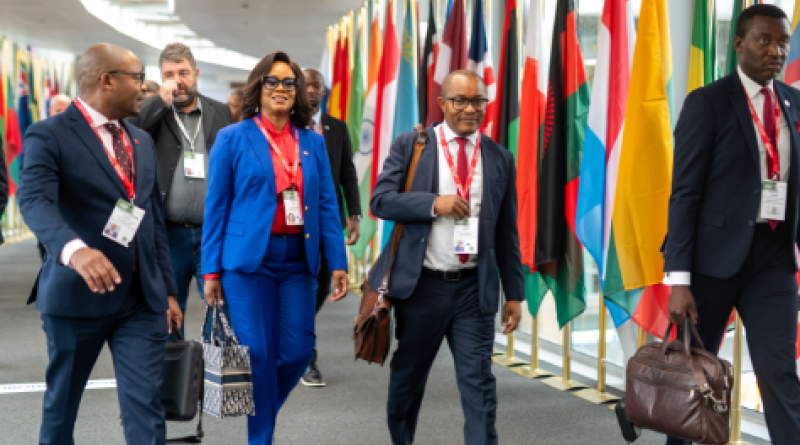
Cover photo: Delegates at Investing in Mining Indaba 2026. Source: Hyve Group.