

Africa: Public-private partnerships key to fixing infrastructure gap, ESI Africa reports from Mining Indaba
Deshan Naidoo, CEO of Afrivolt, warned that Africa’s challenge is no longer identifying solutions but implementing them
Public-private partnerships could provide a practical route to closing Africa’s infrastructure deficit, delegates heard at the Investing in African Mining Indaba, as policymakers, financiers and mining companies pointed to water, energy and transport projects as proof that shared-risk infrastructure models can be replicated across the continent.
The session examined whether South Africa’s Olifants Management Model Programme (OMMP) – a collaborative water-supply system linking government, mining companies and industrial users – could serve as a blueprint for wider African development.
Panelists said the project demonstrated that neither governments nor mining companies can independently finance and operate large infrastructure systems in resource-rich but water-scarce regions.
Bertus Bierman, strategic advisor at the Badirammogo Water User Association, said the model was designed precisely because single actors could not secure reliable supply alone.
“If you want secure water, it is quite difficult for one part… be it government or a single mining company… to achieve that,” Bierman said.
Africa doesn’t lack ideas, pilots or panel discussions… it lacks velocity
He explained the partnership operates on equal footing between public authorities and private users.
“We created a collaborative partnership where both sides are 50-50 partners,” he said, adding that governance structures include a management committee with equal representation and a dedicated executive leadership structure.
The arrangement is embedded within existing legislation, integrating national water resources and industrial users in a single institution.
But, he added, building the partnership proved more complex than building infrastructure itself.
Clear project objectives key
Aligning stakeholders and establishing trust between government institutions and mining companies took significant time, he said, requiring clear project objectives and strong governance from the outset.
“You must have a programme scope that is very clear early in the process so that all parties can work toward a common goal,” Bierman said.
Funding early project preparation was another major hurdle. Banks typically only finance projects once they reach bankable stage, leaving feasibility and study phases difficult to fund.
“We were fortunate that government and the mining industry each funded the early stages,” he said, warning that many African countries may struggle to bridge this financing gap.
Legal certainty also played a decisive role. Operating within South Africa’s water legislation allowed the partnership to be established relatively smoothly, but Bierman noted that similar projects in other sectors would need careful alignment with regulatory frameworks.
The OMMP, panelists said, differs from traditional PPPs: the commercial users’ portion is financed through commercial lenders, while the public component relies on concessional loans and grants, creating two funding streams dependent on the success of the same system.
Blended finance, shared benefit in public-private partnerships
Mohale Rakgate, chief investment officer of South Africa’s Infrastructure Fund, said the objective was to mobilise public and private capital simultaneously to deliver infrastructure benefiting industry and surrounding communities.
“Our mandate is really to do exactly what OMMP has done and mobilise both public and private resources for infrastructure investment that services society as well as commercial users,” Rakgate said.
He said a key design principle was ensuring mining operations did not receive water access while nearby communities were excluded.
“We wanted a situation where the mines get access for production purposes but do not leave adjacent communities behind,” he said.
Government commitment and regulatory support were central to attracting investors, Rakgate added, alongside participation from private financiers and climate-focused investors.
“Government put its money where its mouth is and also helped resolve regulatory and legislative challenges as we structured the project,” he said.
The Infrastructure Fund, he said, is pursuing a broader portfolio aimed at addressing infrastructure backlogs and supporting economic growth by mobilising market funding alongside public resources.
Bankability and scale
Aboubacar Koulibaly, head of country at Rio Tinto Guinée, said Africa’s infrastructure deficit is one of the mining sector’s biggest constraints and cannot be solved by individual projects.
“Africa has huge need for infrastructure, but if a project is not bankable it will be very difficult to tap into public resources,” Koulibaly said.
He noted that collaborative development improves viability.
“Working together as industry partners makes projects more bankable than each project trying to develop infrastructure for itself,” he said.
He added that large projects also require government capacity to execute and regulate effectively, and that shared infrastructure allows broader economic use beyond a single mine.
Role of banks and policy reform
From the financial sector perspective, Kalengo Simukoko, acting CEO of Zambia National Commercial Bank (Zanaco), said PPP projects in transport, logistics and energy have shown promise but depend heavily on policy reform and partnerships.
“Partnerships are key… there are certain aspects government is better positioned to do and others the private sector can do,” Simukoko said.
He added that opening electricity markets and improving regulatory frameworks had increased investor interest by making revenue streams clearer and easier for banks to finance.
Supportive legal and policy frameworks, panelists agreed, are critical for attracting long-term capital.
From discussion to delivery
Moderator Deshan Naidoo, CEO of Afrivolt, warned that Africa’s challenge is no longer identifying solutions but implementing them.
“Africa doesn’t lack ideas, pilots or panel discussions… it lacks velocity. If we keep having the same conversations, we won’t industrialise, we’ll just intellectualise.”
He urged industry, governments and financiers to use their positions and capital to move African infrastructure “from conversation to execution”. ESI
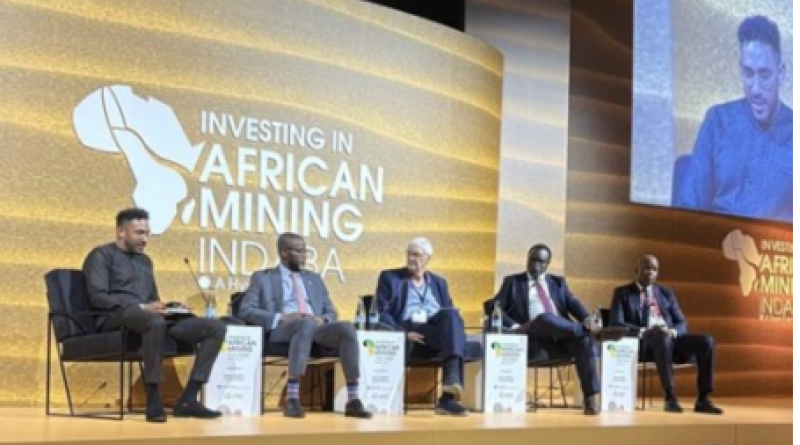
Cover photo: Panelists at Investing in African Mining Indaba discuss the crucial role of public-private partnerships in infrastructure expansion. Source: ESI Africa