

‘Black Rain’, Cancer Risk Make Civilians the Silent Victims of Trump’s War on Iran
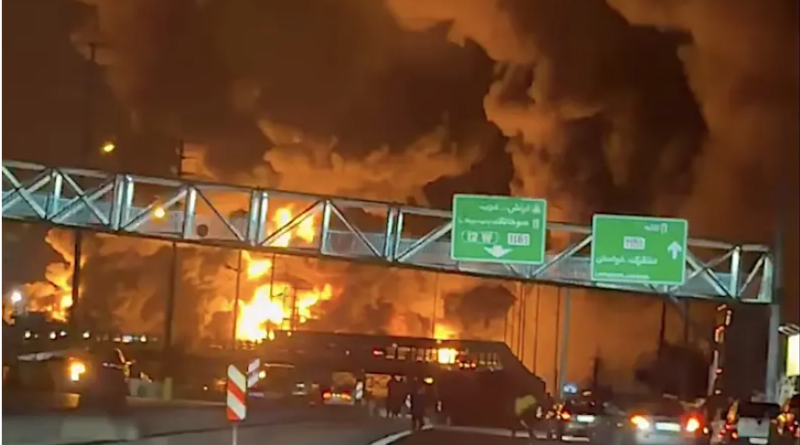
The American/Israeli war on Iran is quickly shaping up as a regional environmental health disaster, after Israel bombed four fuel depots near Tehran and Iran attacked a water desalination plant in Bahrain.
The Tehran bombings, in particular, have generated apocalyptic photos and surreal eyewitness accounts of poisonous smoke and acidified rain that could bring years or decades of health impacts to Iranian civilians. The damage prompted even a “hopped up, aggressive, borderline frenzied,” and apparently gamified U.S. administration to politely ask Israel to stop bombing oil and gas facilities.
“The effect was astonishing—a cloud of truly toxic smoke,” author and Third Act co-founder Bill McKibben writes on his The Crucial Years newsletter. “This was in essence chemical warfare, even if the chemicals were the (easily anticipated) result of ‘normal’ bombs. And it affected an almost entirely civilian population that will be paying the price for decades to come.”
The Israeli strikes “systematically targeted four major [oil] storage facilities and a distribution centre, including the Tehran refinery in the south and depots in Aghdasieh, Shahran, and Karaj,” Al Jazeera reports. “What Israeli and U.S. military planners frame as a calculated degradation of state infrastructure is being described by local officials and environmental experts as an act of total warfare, and collective punishment.”
“The night turned into morning and the morning into night,” one local resident told the New York Times. “With the fire, it felt like night became day, and then with all the smoke the day turned back into night again.”
Pretty much immediately, “black rain fell from the sky, as airborne oil droplets mixed with precipitation and coated streets, cars, plants, and pets,” the Times writes. “Residents reported feeling sick almost immediately after the attacks. Across the city, people said their eyes were burning. Some reported migraines, dizziness, and coughing.”
It’s also likely that the fires contaminated parts of Tehran’s water supply, with spilled oil pouring into gutters and drains, catching fire, and polluting public waterways.
John Balmes, professor emeritus of environmental health sciences at the University of California, Berkeley, told the Times the smoke would contain cancer-causing agents like benzene and formaldehyde. “There are all sorts of nasty, complex hydrocarbons in those black clouds of smoke,” he said.
Social media posts warned civilians in the area that “explosions of oil depots release a large volume of toxic hydrocarbon compounds and sulphur and nitrogen oxides into the atmosphere and clouds which, when it rains, produce very dangerous and highly acidic rain. This phenomenon can cause chemical burns to the skin and serious damage to the lungs.”
One public health advisory continued: “During rainfall after oil explosions, under no circumstances leave your home and cover all openings with a damp cloth. Toxic soot particles suspended in the rain are very fine and can easily enter indoor spaces. If caught outdoors unexpectedly, immediately take shelter under concrete or metal roofs and avoid sheltering under trees. Tree leaves collect acidic droplets and concentrate them, causing more dangerous drops on you.”
U.S. to Israel: Dial It Back
By Monday, news reports had the U.S. telling its military partner to stop targeting oil infrastructure, or at least to give them a heads-up first.
“The U.S. request marks the first time the Trump administration has reined in Israel since the two countries launched their joint operation against Iran,” Axios reports, citing three sources for its story. One of those sources said U.S. officials were concerned about harming members of the public who oppose the Iranian regime. They’re also interested in cooperating with the country’s oil sector after the war is over, and warned about “massive Iranian retaliatory attacks” across the region.
But by then, so much damage had already been done.
Shina Ansari, head of Iran’s environment department, “stated that the environment remains the silent victim of the war, noting that the incineration of vast fuel reserves has trapped the capital under a suffocating shroud of pollutants,” Al Jazeera writes. Deputy health minister Ali Jafarian said the acid rain is contaminating soil and water supplies, while the air poses a toxic risk to seniors, children, and people with respiratory conditions.
“The situation is so frightening it’s hard to describe,” an activist and former political prisoner living in Tehran, who declined to be named, told the Guardian. “Smoke has covered the entire city. I have severe shortness of breath and burning in my eyes and throat, and many others feel the same. But people still have to go outside because they have no choice. Many places reopened today, but closed again because it’s impossible to stay outdoors.”
“This is chemical warfare, as inhumane in its way as the attacks on the girl’s school or on what may have been an unarmed warship off the Sri Lankan coast. And among other things, it completely undercuts one of Trump’s rationales for his assault: that it will free Iranians to rise up against their government,” McKibben writes, in a post that includes photos from the scene. “Revolts, however, generally require people to take to the streets. And that requires breathing the air.”
“When Saddam [Hussein] burned Kuwaiti oil wells in 1991, the fallout contributed to what became known as Gulf War syndrome, with veterans developing chronic illness and cancer decades later,” Iranian Internet commentator Ariana Jasmine added, in a social media post republished on LinkedIn. “The difference now: this isn’t a desert battlefield, it’s a city of 10 million people, most of them women and children.”
The U.S. issued a denial after Iran accused it of attacking a desalination plant on Qeshm Island that served 30 villages, in an already-dry region where climate change has triggered more frequent and severe drought. In response, an Iranian drone attack damaged a plant in Bahrain, which relies heavily on desalinated water.
“Hundreds of desalination plants stretch along the Persian Gulf coast—all of them within reach of Iranian drones and missiles,” the Globe and Mail writes. “If those facilities collapsed, 100 million people across the region would lose their lifeline to drinking water.”
ProPublica recounts how the U.S. spent several years developing plans to reduce or avoid civilian deaths due to military operations. The work began during the first Trump administration under then-defence secretary James Mattis, then continued during the Joe Biden presidency.
But “today, that momentum is gone,” ProPublica’s feature story states. “The civilian protection mission was dissolved as Defense Secretary Pete Hegseth made ‘lethality’ a top priority….
“Dismantling the fledgling harm-reduction effort, defense analysts say, is among several ways the Trump administration has reorganized national security around two principles: more aggression, less accountability.”
On Wednesday, Amnesty International warned that millions of people are at risk as Israel, the U.S., and Iran illegally attack fossil energy infrastructure. “The potential for vast, predictable, and devastating civilian harm caused by strikes on energy infrastructure—including uncontrolled fires, major disruptions to essential services, environmental damage, and severe long-term health risks for millions—means such attacks carry a substantial risk of violating international humanitarian law and, in some cases, could amount to war crimes,” warned the organization’s Middle East and North Africa Director Heba Morayef.
“Regardless of whether a military objective is cited to justify targeting energy infrastructure, under international humanitarian law all parties have a clear obligation to take all feasible precautions to reduce civilian harm and refrain from attacks that cause disproportionate death or injury to civilians or damage to civilian objects.”
Civilians Harmed, Russia Wins
Apart from oil market traders and U.S. fossil companies—including at least two major Trump donors—that stand to gain, Russia is emerging as an early winner from a war that has had oil prices ricocheting as high as US$119 per barrel, and is expected to keep those prices high for months.
Over time, an avalanche of analysis suggests that the instability of Middle Eastern oil will prompt countries to speed up the shift to clean, low-carbon electricity. But more immediately, “as an oil-producing country—even one under sanction—Russia couldn’t have gotten more welcome news,” writes Globe and Mail columnist Gary Mason. “Even better, the U.S. has lifted sanctions on Russian oil going to India, allowing it to reach that massive market without penalty.”
That oil is also selling at a higher price per barrel because of the war, Reuters reports.
So far, Vladimir Putin’s regime has taken in about €510 million per day from fossil fuel exports since the war began, about 14% more than the average for February, Sassenberg, Germany-based Urgewald reported this week, in a release based on analysis by the Centre for Research on Energy and Clean Air.
“Russia is already profiting from this geopolitical crisis,” said Urgewald sanctions campaigner Alexander Kirk. “That is the reality of fossil fuel geopolitics. When markets panic, authoritarian exporters cash in. In less than two weeks, Russia has earned an estimated €6 billion from fossil fuel exports, money that ultimately feeds the Kremlin’s war machine.”
Cover photo: Oil refinery fire in Tehran/Facebook