

Europe swaps climate rhetoric for energy security talk to defuse MAGA backlash
U.S. anti-climate attacks at a meeting in Paris this week prompted a remarkable shift in tone from European countries.
PARIS — European countries are holding their tongues and toning down the climate rhetoric even as they keep investing in renewables, in a bid to keep an increasingly anti-green United States onside.
At a tense ministerial gathering this week of the International Energy Agency, the world’s most influential energy body, European ministers avoided overt support for climate initiatives, instead focusing on the energy security benefits of renewables.
It was a direct response to threats from the U.S., which had earlier in the week warned it would quit the body if it didn’t drop its “climate advocacy”.
“Nobody is willing now to stand loudly and directly against the U.S. in these conversations,” said a senior official from an Eastern European country, while emphasizing it would be “silly” not to keep developing renewables.
Others were more diplomatic. “I am convinced, having spoken with [U.S. Energy Secretary] Chris Wright, that we can find common ground,” French Economy Minister Roland Lescure told journalists on the sidelines of the summit, citing nuclear energy as an example. France, Europe’s atomic heavyweight, hosts a major nuclear summit in Paris next month to which Wright has been invited, Lescure added.
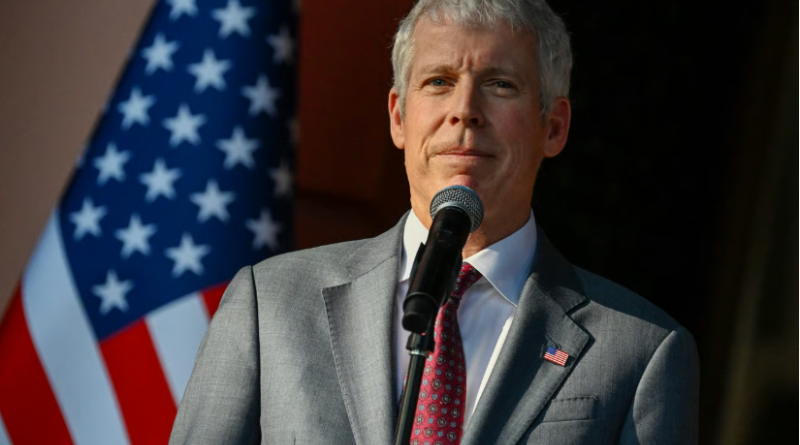
A quiet consensus to drop the green rhetoric formed after repeated fiery interventions from Wright over the course of the event, which concluded with the IEA almost completely excising "climate change" from its post-summit communications. It was a striking turnaround from the last ministers' meeting two years ago, when the IEA's top priority was defined as addressing the climate crisis and phasing out fossil fuels.
Ministers, senior officials and ministerial advisers told POLITICO that the event had cemented a long-running rebranding of the green transition that emphasizes the security benefits of renewables rather than their climate-saving potential. It’s a change that has been slowly building since U.S. President Donald Trump returned to office 13 months ago, and that was turbocharged by Wright’s threats on Tuesday to quit the IEA and fears Washington might stop funding the body. The U.S. provides around 14 percent of the IEA's funding.
“With diplomacy it’s about looking for those places where you can work together,” said one European energy ministry official present at the closed-door discussions. “If the word 'climate change' is a red drape for a bull then don’t use it.”
The emphasis on security — not climate change — was everywhere.
“Renewable energy is not about tackling climate change, it’s about economic growth and affordable and low energy prices,” Austrian State Secretary of Energy Elizabeth Zehetner told POLITICO on the sidelines of the event. Zehetner stressed however that Europeans wouldn't be "blackmailed" by the U.S.
Her comments reflect that independently of the U.S., Europe has itself moved away from the climate fervor that dominated Brussels policymaking in the first part of this decade. Still, despite some backsliding on green rules, the EU remains fundamentally in favor of strong policies to tackle climate change.
Downplaying and dealmaking
But officials said collaboration remained possible, and that European countries could work with the U.S. commercially to fill gaps in Europe's energy mix, highlighting growing imports of U.S. liquified natural gas and collaborations on nuclear power.
Britain’s approach is to “find common ground with as many countries as possible,” U.K. Energy Secretary Ed Miliband told POLITICO. “For example, [on] nuclear, we found common ground with the U.S., and that's really important.”
Finnish Energy and Climate Minister Sari Multala said countries should “build on those things we have in common,” saying collaboration with the U.S. “would be possible.”
Greece’s Deputy Energy Minister Nikos Tsafos, also present at the conference, said a growing Greek push to transit U.S. LNG from its ports into neighboring countries was “really important in bringing down gas prices” and that it was just one prong in a broader diversification strategy that includes renewables. He rejected EU concerns that the U.S. could weaponize the gas flows.
Some government officials from Eastern European countries that are still reliant on fossil fuels even agreed with Wright’s assessment that the influential net-zero scenarios championed by the IEA — which inform global climate policymaking as well as billions of dollars of energy investment — are impractical. The agreement supports Wright's claim that some ministers had supported his comments behind closed doors.
Europe's “high ambitions” to reduce emissions by 90 percent by 2040 will be “very difficult … due to the energy mix,” said Polish Energy Minister Miłosz Motyka in an interview at the summit, citing Poland’s continued reliance on coal even as it rapidly expands its renewables capacity.
“The last 10 percent will be really difficult … the marginal costs … are really high,” added the senior energy official from an Eastern European country, who was also present at the gathering. “Many member states are silently agreeing that it’s not possible for some industries.”
But officials were also at pains to emphasize that Europe cannot actually stop investing in renewables, which have become a vital source of energy for countries that are trying to slash dependence on Russia and diversify their supplies amid a broader turn to energy self-sufficiency.
According to two people present behind closed doors, one of the few energy ministers to openly challenge Wright’s arguments was Spanish Energy Minister Sara Aagesen, who pointed out that Spain doesn't boast rich oil fields and gas fields like the U.S. but rather “solar fields” — highlighting that for Europe, “energy security” has a different meaning. A spokesperson for the Spanish energy ministry didn't respond to multiple requests for comment.
“Washington can make their own politics — we have our own initiatives here,” agreed Maja Lundbäck, Sweden’s state secretary for climate and enterprise.
Some officials expressed hope that the U.S. will recognize the importance of renewables for Europe, hinting that Wright, behind the scenes, was more accommodating of this reality. At a press conference on Thursday he acknowledged that Europeans are "free to engage in any agenda they want," even if the IEA should not.
And for all the emphasis on security, nobody openly derided the IEA’s net-zero forecasting — and its broader implications for European policymaking — when pushed.
“Poland appreciates the data” provided by the IEA, said Polish minister Motyka. “It shows that this energy transformation is a chance for energy sovereignty. Keeping the current direction that the International Agency has is legitimate.”
Caught between the camps is IEA Executive Director Fatih Birol, who is nearing the end of a tenure that has transformed the agency from an oil security watchdog into a central voice on the clean energy transition.
Under Birol, the IEA published landmark net-zero pathways and sharply reduced projections for long-term fossil fuel demand, moves that drew praise from European capitals and ire from Republican lawmakers in Washington.
But Wright was careful not to personalize the dispute. “The goal of the United States … is to return the agency to its mission,” he told POLITICO, saying Washington remains “neutral” on future leadership.
Cover photo: A quiet consensus to drop the green rhetoric formed after repeated fiery interventions from Chris Wright over the course of the event, which concluded with the IEA almost completely excising "climate change" from its post-summit communications. | Juan Barreto/AFP via Getty Images