

Mining solar and storage innovations to reduce carbon footprints
Although not their core business, mining houses increasingly focus on investing in and implementing clean technologies into their operations

When it comes to energy, mine operations worldwide are reporting their adoption of renewable energy solutions. Let’s explore the projects leading this shift on African soil.

Mining companies are increasingly exploring renewable energy (RE) technologies to respond to pivoting market expectations. Fortunately, this response effectively reduces greenhouse gas (GHG) emissions, mitigates power supply risks, buffers against fossil fuel price volatility, and complies with evolving global regulations—such as the European Union’s (EU) Carbon Border Adjustment Mechanism (CBAM).

Although not their core business, mining houses of all sizes are increasingly investing in and implementing clean, green technologies in their operations. This tech is becoming integral to mining operations worldwide, from solar and wind to hydropower and battery storage.

For example, Vale’s smelters in Indonesia are powered entirely by hydroelectric energy and in Chile, the Zaldívar copper mine transitioned to 100% renewable electricity in July 2020.

While often located in remote, infrastructure-poor regions, mine operations in Africa are spearheading a renaissance of sustainable tech designed for local conditions.


Technical and economic hurdles

Despite this growing interest, integrating RE of any type into mining operations presents significant challenges. From a technical perspective, mining operations require a constant energy supply, but RE’s intermittency brings a certain degree of uncertainty.

High upfront CAPEX for these systems also makes mining companies hesitant to adopt them, while location and installation challenges pose a significant technical barrier.

Paul Miller at Decentral Energy tells ESI Africa that selecting appropriate sites is another challenge. Communities are usually settled on the land, and most available nearby vacant flat land is earmarked for tailing storage facilities.

“What is perhaps more difficult is where a mine has a relatively short remaining life, where the renewable energy facility will outlive the mine itself, complicating the financing arrangements,” says Miller.

Other challenges are insurmountable and do not justify the investment, such as mines being creditworthy, lacking the capital themselves, or having a lifespan that is too short. Miller advises building plants on mines but designing them to be wheeling-ready so that if the local load user, the mine, closes, the power can be wheeled elsewhere across the grid.

In closing, he shares that mines that have taken the route to RE tech have learnt the lessons of taking too long to complete procurement and to get MWs up and running. “A 5% price saving from a 3-year procurement process is much less than the lost benefit of taking so long.”

ESI Africa will continue to report on these developments as the number of case studies grows, driven by declining costs of solar equipment and battery storage. The trend will continue to accelerate, but with a move toward more decentralised technologies and a greater integration of digital solutions and data analytics.

Egyptian case study: Sukari Gold Mine

In April 2023, the Sukari Gold Mine in Egypt inaugurated a 36MW solar power station, along with a 7.5MW battery storage system, to supply the facility with electricity.

Since early September 2022, the solar plant consistently delivered 36MWDC (nameplate capacity), converting to 30MW of solar power.

Sukari is Egypt’s first large-scale modern mine. It is served by tarmac roads, off-grid power, solar and a 25km water pipeline fed by the Red Sea. The station is in the Eastern Desert, an area with the highest solar irradiation for about 10 hours daily.

The switch to this RE source has reduced exposure to volatile fuel prices, with commissioning saving up to 70,000 litres of diesel per day and, on average, reducing diesel consumption by 22 million litres annually. This decrease also equates to potential annual cost savings of $20 million at 2023 diesel prices.

Furthermore, the solar plant is expected to reduce GHG emissions by 60,000t CO₂  equivalent per annum and a subsequent reduction in the volume of diesel trucked to the site, which uses ICE vehicles.

Continued discussions are underway to assess the feasibility of using Egyptian grid power at Sukari. To that end, there has been active engagement with the government and IPPs.

Initial proposals to supply 30-50MW of grid power to Sukari have been received, and the potential to entirely displace diesel use for power generation at the Sukari mine has been identified.

The minimum 30MW of grid power combined with the existing 30MW of solar power creates the potential to operate during daylight hours without any diesel power generation and substantially offsets diesel consumption during nighttime hours.

Grid proximity to the site and existing infrastructure indicate a low capital intensity. Egyptian grid power is generated from natural gas and a mix of renewables, such as hydro, solar, and wind, creating an opportunity to further reduce Sukari’s GHG emissions.

In the context of ESG, an educational endeavour is underway to establish a mining school in Egypt, initiated by Centamin and continued under AngloGold Ashanti’s stewardship.

The institution’s focus will be on equipping local youth with essential mining skills, thereby fostering local expertise and contributing to the industry’s sustainable development.

QIT Madagascar Minerals (QMM) took an essential step towards decarbonising its ilmenite mine in Fort-Dauphin through a partnership with CrossBoundary Energy to build and operate a solar and wind power plant.

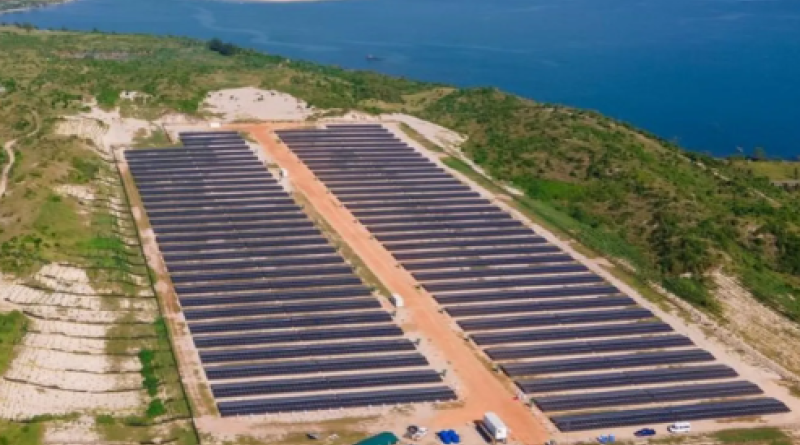
The first phase of the Ehoala Solar Park, inaugurated in April 2024, comprises 14,640 solar panels generating 8MW.

The project’s second phase includes expanding the solar farm by 6MW and the construction of a 19-turbine wind farm with a capacity of 16MW. Additionally, with an 8,25MW Battery Energy Storage System (BESS) solution, the plant will provide 60% of QMM’s energy, making it the largest renewable penetration project for a mine in Africa.

This transition to renewable energy is part of QMM’s efforts to build a sustainable mine by adopting responsible practices such as reducing emissions, managing waste and water responsibly, and restoring the local environment.

QMM is a joint venture between Rio Tinto (80%) and the government of Madagascar (20%), also producing zirsill, used to make ceramic tiles and electronics, and monazite, a rare earth mineral used in renewable energy technologies, such as high-power permanent magnets for wind turbines and electric vehicles.

According to the IEA, Madagascar’s energy mix was dominated by biofuels and wastes (85%) in 2019, with oil products (11%), coal and hydropower accounting for the rest of the total energy supply.

The solar power plant, involving various Malagasy institutions, is an essential step towards realising QMM’s sustainable mine vision while providing tangible benefits such as job creation and skills development for the local community.

In Mali, B2Gold completed the Phase 2 expansion of the Fekola Solar Plant, which became operational in January 2025. This involved adding 46,200 additional solar panels, bringing the total panel count to 142,912.

At full capacity, the expansion of the Fekola Solar Plant will provide an additional 22MW of solar capacity (52MW total) and 12,7MWh of battery capacity (27,7MWh total).

The process for this phase began in June 2023 with land clearing and road construction and progressed to physical equipment construction in February 2024.

The construction of the Fekola Solar Plant created more than 120 local jobs, with 13 individuals trained to maintain the expansion area post-completion, the company said. B2Gold also partnered with a local drilling company for services.

The expanded Fekola Solar Plant is expected to reduce annual emissions by an estimated 63,000 tonnes of carbon dioxide equivalent (CO₂e) and reduce the annual consumption of heavy fuel oil (HFO) by an estimated 20 million litres.

It is also expected to supply approximately 30% of the site’s total electricity demand and is one of the largest off-grid solar/HFO hybrid power plants in the world.

Ken Jones, director of sustainability for B2Gold, explained that expanding the plant is a significant initiative in support of the company’s emission reduction target. “The expanded facility will allow the Fekola site team to turn off the HFO plant for a portion of the day during times of sufficient solar radiation.”

B2Gold said it is actively exploring and implementing RE sources for global operations while also pursuing decarbonisation initiatives to mitigate climate risks and achieve a 30% reduction in Scope 1 and 2 GHG emissions by 2030, compared to a 2021 baseline.

B2Gold acquired the Fekola project in 2014 through a merger with Papillon Resources Limited. The Fekola Complex is located in southwest Mali, on the border between Mali and Senegal, approximately 500km due west of the capital city, Bamako.

Mozambican case study: Balama graphite mine

In this exemplary project, the operations and ownership of the Solar and Battery Hybrid Power System in Mozambique will be transferred to Syrah Resources at nil cost at the end of the 10-year BOOT term.

On average, the 11,25MWp solar and 8,5MW/MWh BESS at Balama graphite operation will reduce diesel consumption for power generation by 35%.

During peak daylight hours, the solar battery system can supply 100% of Balama’s power requirements, taking advantage of the site’s high solar irradiation potential.

The solar PV array, comprising 20,832 solar modules with a surface area of around 5.4 hectares, integrates fully with a battery system.

The 10-day operational testing in October 2023 integrated power supply from the solar and battery hybrid system and diesel genset, achieving:

  • ~33% of the total power was supplied by the solar and battery hybrid system;
  • ~34% average savings in diesel consumed per kWh power generated, equating to ~16,000 litres of diesel savings per day, and an improvement shown in the stability and efficiency of the diesel gensets; and
  • on average, the hybrid plant and site deliver power for eight hours daily during daylight hours.

This power plant will contribute at least 35% of the average site power requirements for the Balama graphite operation. Mine operator Syrah Resources’ lifecycle assessment estimates that the solar battery hybrid system will reduce the Global Warming Potential (GWP) or product carbon equivalent emissions from the mine and transport to Nacala port from 0,48kg to 0,42kg CO₂ equivalent per 1kg of natural graphite. This is a 12,5% reduction.

Furthermore, the system is estimated to reduce Balama’s GWP by 18kt CO₂ equivalent per annum, on average, over the life of the operation.

Syrah Resources managing director and CEO Shaun Verner said the entire Solar and Battery Hybrid System operations are the culmination of an extensive feasibility study, equipment procurement, construction and commissioning activities completed over several years. ESI

Cover photo:  : Ehoala Solar Park, Madagascar. Source: Rio Tinto
g