


Mining Indaba: Grid investment key to powering Africa’s growth
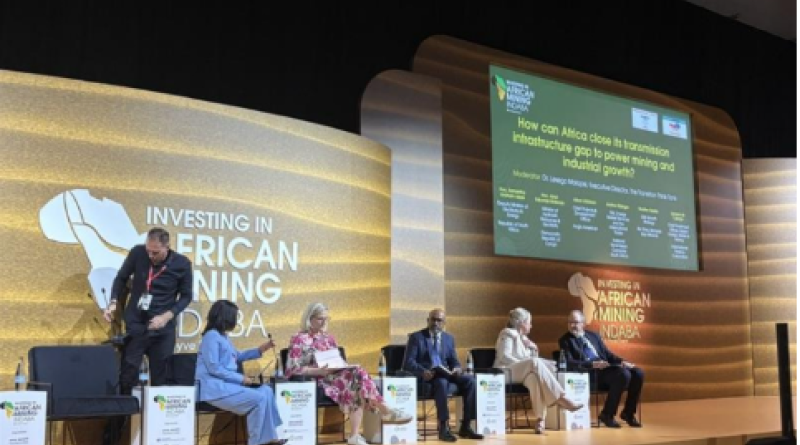
Closing Africa’s transmission infrastructure gap will be central to unlocking mining expansion, industrialisation and the energy transition, panellists said at the Investing in African Mining Indaba this week.
Speaking during a session titled How can Africa close its transmission infrastructure gap to power mining and industrial growth?, policymakers, utilities and mining executives agreed that the continent’s energy challenge is no longer primarily about generation – but about getting electricity to where it is needed.
Loadshedding exposed the real bottleneck
South Africa’s Deputy Minister of Electricity and Energy, Samantha Graham-Maré, said the country only fully recognised the scale of the transmission problem while responding to the loadshedding power crisis.
“For years we focused on generation. But when we started bringing new capacity online, we suddenly discovered a transmission issue. It is pointless bringing energy online if you cannot send that energy to where it is required.”
South Africa’s grid, historically built around coal stations in Mpumalanga, was not designed to accommodate renewable energy projects located far from demand centres.
Africa’s next energy breakthrough will not come from building more power stations alone, but from building the wires that connect them to the economy
As solar and wind capacity expanded, the mismatch exposed severe network constraints.
The country now needs roughly 14,000km of new transmission lines over the next decade. Graham-Maré said government cannot fund this expansion alone and has launched an independent transmission procurement programme aimed at attracting private investment.
“The loadshedding crisis forced government to think creatively and bring in private sector participation,” she said, adding that industry financing and expertise were now essential to infrastructure delivery.
She also warned that the problem extends beyond South Africa. Historically, the vast majority of energy investment across Africa has gone into power plants rather than networks – a structural imbalance that now limits industrial growth.
Mining investment tied to grid access
For mining companies, transmission constraints are already shaping investment and decarbonisation strategies.
Bradley Reddy, general manager for growth strategy at Rio Tinto’s Richards Bay Minerals, said energy reliability is critical for energy-intensive operations that consume large volumes of electricity annually.
“Energy security is key for our ability to operate, grow and decarbonise responsibly,” he said.
The company secured long-term renewable power purchase agreements and significant new capacity, allowing it to substantially reduce emissions. However, he said many renewable projects cannot connect to the grid because transmission capacity is unavailable.
“Limited access from a transmission perspective constrains opportunities and affects our decarbonisation pipeline,” Reddy said. Grid availability is therefore becoming a decisive factor in investment decisions.
Partnerships and market reform
Mining houses argue the same partnership model used to unlock private generation should be applied to transmission.
Alison Atkinson, chief projects and development officer at Anglo American, said collaborative ventures between mining companies, utilities and government had already delivered hundreds of megawatts of renewable capacity.
“That partnership was key to attracting finance and ensuring security of supply. I see no reason why grid development cannot partner in the same way.”
She added that reliable electricity is essential not only for mining operations but for refining and critical minerals processing – sectors central to global energy transition supply chains. Without adequate grid capacity, smelters and industrial facilities face closure.
Atkinson also highlighted the growing role of micro-grids and market liberalisation in expanding access and attracting investment across communities and industry.
Transmission reform under way
Andrew Etzinger of the National Transmission Company South Africa (NTCSA) said structural reforms – including Eskom’s unbundling and the creation of a dedicated transmission operator – are intended to enable a functioning electricity market and attract capital.
A regional approach is also emerging. The Southern African Power Pool, one of the world’s oldest electricity trading systems, is developing a regional transmission investment fund to finance interconnectors and support cross-border trade.
Regional grid integration, including future links with East Africa, could allow countries to tap into hydropower resources and balance supply across borders.
Skills and system stability
Beyond funding, Graham-Maré emphasised that technical expertise will be as critical as infrastructure investment. Integrating renewable energy into an ageing grid requires new operational skills and careful management to maintain stability.
She stressed that transmission networks remain strategic national infrastructure and must be securely operated even while private investment is mobilised.
“The key investment is not only infrastructure, but skills and technical know-how to manage and keep the grid stable.”
From generation to networks
Panellists concurred that Africa’s electricity shortage is increasingly a delivery problem rather than a production problem.
They highlighted that without expanded transmission networks, new power plants – including renewable projects – cannot support mines, smelters and manufacturing hubs. Conversely, a stronger grid could unlock regional power trade, accelerate decarbonisation and attract industrial investment.
Panellists concluded that Africa’s next energy breakthrough will not come from building more power stations alone, but from building the wires that connect them to the economy. ESI
Cover photo: By ESI